BreakWave EA Review
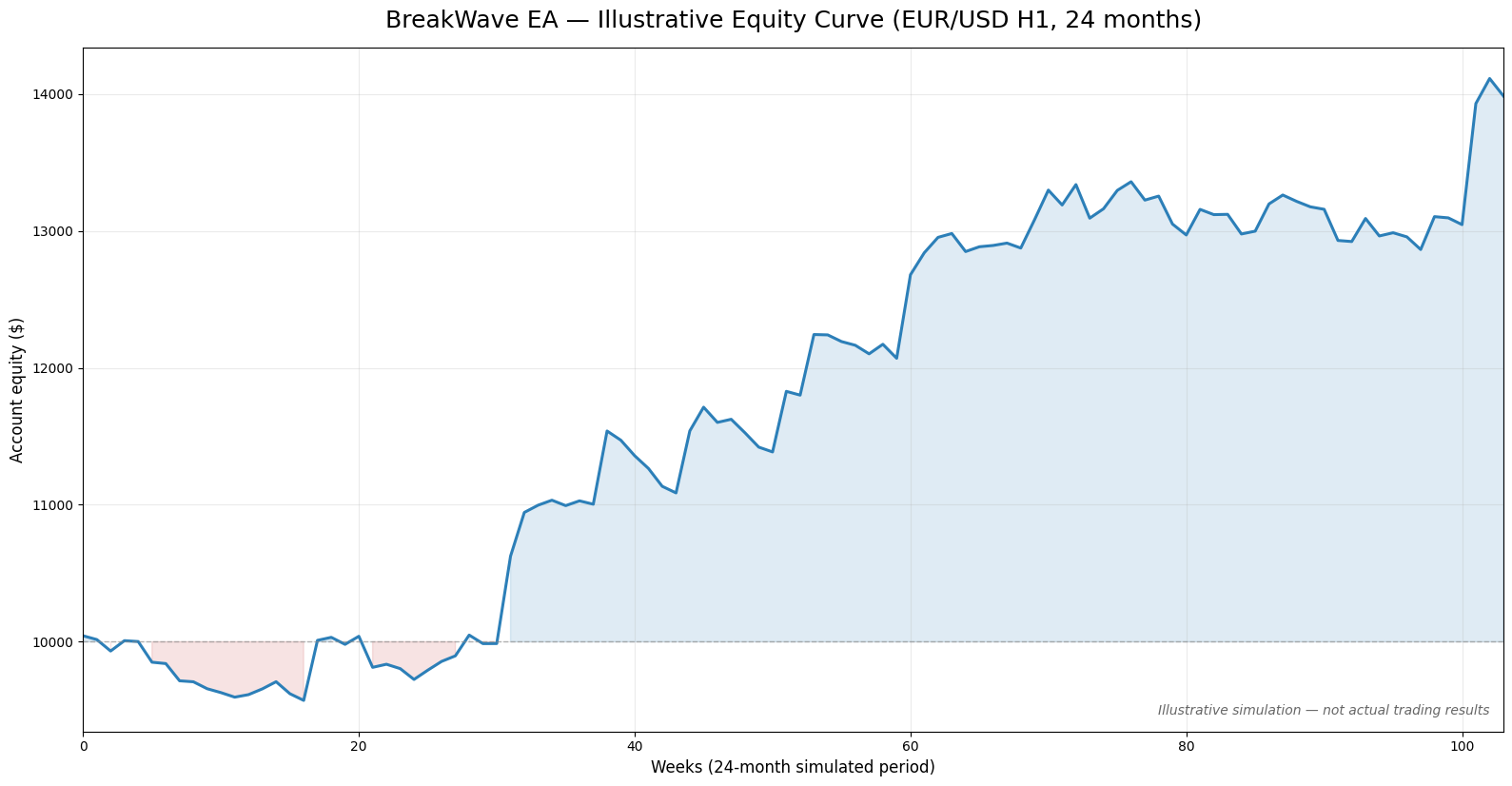
BreakWave is a free breakout Expert Advisor for MetaTrader 4 and MetaTrader 5 that detects low-volatility compression with Bollinger Bands and trades the subsequent expansion. It pairs squeeze detection with ADX trend confirmation and ATR-based dynamic stops to filter out false breakouts.
What is Breakout Trading?
A breakout occurs when price escapes a defined range or volatility envelope with momentum. Breakout traders enter as the range fails, betting that the energy released by the breakout will carry price meaningfully further before the next consolidation.
Key advantage: Breakouts offer asymmetric risk/reward — the failed-range level becomes a tight stop, while a successful breakout often delivers multi-ATR moves before the next pause.
How BreakWave Works
- Squeeze detection — Continuously measures Bollinger Band width relative to ATR; flags a squeeze when band width compresses below the configured ratio
- Direction trigger — Waits for price to close outside the Bollinger Bands after a squeeze, signaling the breakout direction
- ADX confirmation — Requires ADX above the threshold (default 20) so the breakout is backed by trend strength, not just a single spike
- Directional filter — Uses the +DI/−DI crossover to confirm bias matches the close-outside-bands direction
- Dynamic exits — Sets ATR-based stop and target, then trails the stop as the breakout extends
Entry Conditions
Buy signal:
- Bollinger Band width / ATR ratio is below the squeeze threshold (compression detected)
- Current candle closes above the upper Bollinger Band
- ADX is above 20 and +DI > −DI (trend strength + bullish direction)
Sell signal:
- Bollinger Band width / ATR ratio is below the squeeze threshold
- Current candle closes below the lower Bollinger Band
- ADX is above 20 and −DI > +DI (trend strength + bearish direction)
Risk Management (Built-in Safety)
BreakWave ships with multiple protections enabled by default:
| Layer | Default | Purpose |
|---|---|---|
| Risk per trade | 2% of balance | Caps position-sizing risk |
| Stop loss | 1.5× ATR | Volatility-adaptive stop |
| Take profit | 2.0× ATR | ≈ 1:1.33 risk/reward |
| Trailing stop | 1.0× ATR (after 1.0× ATR profit) | Locks in breakout gains |
| Max concurrent trades | 3 | Limits exposure during multi-pair runs |
| Max daily trades | 5 | Caps overtrading on false squeezes |
Configuration
| Parameter | Default | Range | Description |
|---|---|---|---|
| RiskPercent | 2.0 | 0.5–5.0 | Account % risked per trade |
| BB_Period | 20 | 14–30 | Bollinger Bands lookback |
| BB_Deviation | 2.0 | 1.5–2.5 | Bollinger Bands standard deviations |
| SqueezeRatio | 0.5 | 0.3–0.8 | BB width / ATR ratio to flag squeeze |
| ADX_Period | 14 | 10–20 | ADX lookback |
| ADX_Threshold | 20 | 15–30 | Minimum ADX to confirm breakout |
| SL_ATR_Multi | 1.5 | 1.0–2.5 | Stop-loss as ATR multiple |
| TP_ATR_Multi | 2.0 | 1.5–3.5 | Take-profit as ATR multiple |
| TrailATR | 1.0 | 0.5–2.0 | Trailing stop ATR distance |
Recommended Settings by Account Size
| Account size | RiskPercent | SqueezeRatio | ADX_Threshold | MaxTrades |
|---|---|---|---|---|
| $200 – $500 | 1.0 | 0.6 | 25 | 2 |
| $500 – $2,000 | 2.0 | 0.5 | 20 | 3 |
| $2,000 – $10,000 | 2.0 | 0.5 | 20 | 3 |
| $10,000+ | 1.5 | 0.45 | 18 | 4 |
Smaller accounts use stricter filters (higher squeeze ratio and ADX threshold) to trade less often but with higher conviction. Larger accounts can afford to take a slightly looser filter and trade more breakouts.
Best Pairs and Timeframes
- Timeframe: H1 (1-hour) — long enough for squeezes to form, short enough for several setups per week
- Pairs: EUR/USD, GBP/USD — clean breakout behavior with tight spreads
- Avoid: Sustained-trend pairs without consolidation phases (e.g., currencies in central-bank divergence cycles where price rarely sits still)
Strengths and Risks
Strengths
- Catches the biggest moves of the week — breakouts typically produce the largest single-trade ranges
- The ADX filter cuts out most false breakouts that plague naive squeeze EAs
- Sits flat (no losses) during quiet markets — patience is built in
- Asymmetric payoff: a small ATR stop vs. multi-ATR runs when the breakout sticks
Risks
- False breakouts still occur — price escapes the bands, hits the ADX threshold, then immediately reverses
- Long flat periods between breakouts can feel like the EA is “broken” (it isn’t — that’s the design)
- News-driven gaps can blow through the ATR stop on illiquid pairs
- Lower trade frequency means equity grows in steps rather than smoothly
How to Get Started
- Open a free XM account (≈3 minutes)
- Register your account to activate the EA
- Download BreakWave EA (both MT4 .ex4 and MT5 .ex5 are provided)
- Install on MetaTrader following our step-by-step guide
- Attach to an H1 chart of EUR/USD or GBP/USD and confirm “AutoTrading” is enabled
How BreakWave Compares to Our Other EAs
| SteadyPips | GridMaster | BreakWave | TripleAlign | |
|---|---|---|---|---|
| Style | EMA trend | Grid trading | Breakout | Multi-EMA trend |
| Best market | Trending | Ranging | Range → breakout | Strong trends |
| Entry logic | EMA crossover | Fixed grid levels | BB squeeze + ADX | Triple EMA + ADX |
| Risk:reward | 1:1.33 | Variable | 1:1.33 | 1:2 |
| Trade frequency | 3–8 / week | Continuous | 2–5 / week | 1–3 / week |
Frequently Asked Questions
How is BreakWave different from SteadyPips and GridMaster? SteadyPips rides established trends, GridMaster profits from ranges, and BreakWave catches the transition from range to trend. The three EAs cover complementary market phases — running all three on different charts smooths overall equity because each one earns when the others are sitting flat or struggling.
Can I run BreakWave alongside other EAs? Yes, on separate charts. Each EA in the SteadyPips suite uses a unique magic number (BreakWave defaults to 88801) so order tracking never conflicts.
What happens during low-volatility periods? Nothing — by design. BreakWave waits patiently during calm markets. The squeeze detection only fires when volatility first contracts and then expands, avoiding false signals during extended quiet periods.
What’s the typical trade frequency? On H1 you can expect roughly 2–5 trades per week per pair, depending on how often the market consolidates and then releases. Some weeks will see zero entries — that is the filter doing its job.
Do I need a VPS? Recommended. Breakouts often happen at session opens (Tokyo, London, New York), so a stable always-on connection ensures you don’t miss the entry candle. See our VPS guide.
Further Reading
- What Is an Expert Advisor? — Beginner’s primer on EAs
- Technical Analysis Basics — Indicator fundamentals (BB, ADX, ATR)
- How to Install an EA on MetaTrader — Step-by-step setup
- How to Backtest a Forex EA — Validate the settings before going live
- Forex Risk Management Guide — Protect your capital
- Forex Trading Sessions — Why breakouts cluster at session opens
- VPS for Forex Trading — Keep the EA running 24/5
- SteadyPips EA Review — Compare with our trend EA
- GridMaster EA Review — Compare with our range EA
- TripleAlign EA Review — Compare with our stricter trend EA
Important Disclaimers
- Breakout trading involves significant risk including false-breakout losses. Past performance is not indicative of future results.
- The equity curve above is an illustrative simulation, not a guarantee.
- This EA does not guarantee profits.
- Always test on a demo account before committing real funds.
- Never trade with money you cannot afford to lose.
Affiliate Disclosure: This page contains affiliate links to XM. We receive a commission when you open an account through our links, at no additional cost to you. Full disclosure