Quick Answer: To choose a forex broker, check five things in order of importance. First, confirm on the regulator’s public register that the company named in your client agreement is licensed. Second, learn what that regulator actually protects: segregated money, negative balance protection, any compensation scheme. Third, test withdrawals with a small deposit. Fourth, compare total cost per trade on your pair and account type. Fifth, confirm platform and Expert Advisor support. Leverage and bonuses should not decide it.
Most “best broker” round-ups are a ranking with an affiliate link attached. That is not very useful: the broker that suits a $200 account in Kenya isn’t the one that suits a $20,000 account in Germany, and the entity that onboards you, which decides your actual protection, depends on where you live, not which site you read. This page is a method you can apply to any broker, followed by six brokers run through it.
Disclosure: SteadyPips is an Introducing Broker for XM; XM pays us if you open an account via a link here. The other five brokers below don’t. Full detail is in “How This Page Is Funded” below; see also our Editorial Policy.
How Do You Choose a Forex Broker? A Step-by-Step Checklist
Work through the steps in this order. Each one can rule a broker out, and the early steps are the ones a low spread cannot make up for.
- Find the legal entity that will hold your money. Large brokers are groups of separate companies. “FCA regulated” on a homepage often means one subsidiary is FCA regulated while your account agreement is with an offshore sibling. Find the company name in the client agreement: that name, not the brand, is who owes you your balance.
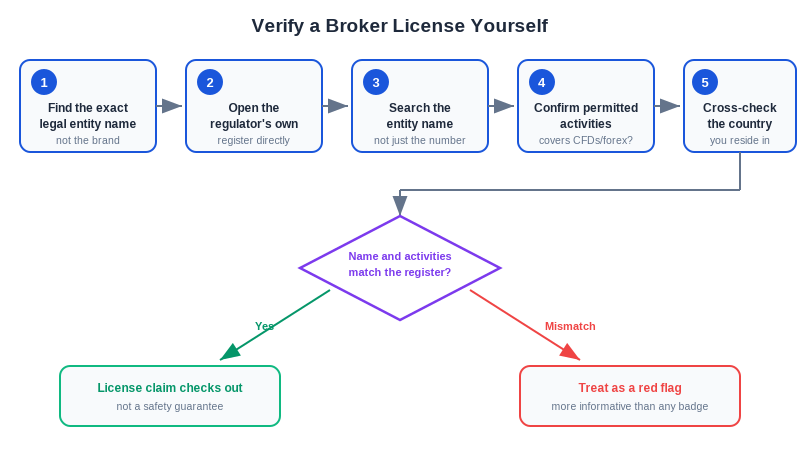
- Verify that entity on the regulator’s register. Search the regulator’s own register, not the broker’s badge (see what to check for regulation below, and our walkthrough of how to verify a forex broker’s licence). If this fails, stop here: nothing else about the broker matters.
- Read what that regulator protects. Segregation, negative balance protection and compensation differ by jurisdiction and do not follow you to an offshore entity. Our forex broker regulation guide compares the tiers.
- Test withdrawals before funding properly. Harder to research and more important than spreads. Deposit a small amount, trade it, withdraw it, and time the round trip.
- Compare the total cost per trade. Spread plus commission plus swap, on the pair and account type you will actually use, not the headline “from” spread.
- Confirm the platform fits how you trade. To run an Expert Advisor you need MetaTrader 4 or 5 with no restrictions on automated trading; to trade manually on a phone, none of that matters.
- Practise on demo, then start small. Learn the platform where mistakes are free (demo account guide), size each trade from risk rather than from available leverage (lot sizing), and only then scale. Re-read the agreement if your account is ever migrated to another entity.
Leverage is mostly a distraction. A trader on 1:30 and one on 1:1000 can open the same position; the difference is only how much margin sits idle. High leverage does not improve a strategy, it shortens the time until a mistake becomes terminal. A low minimum deposit is marketing, not a reason to choose: it is an account-opening threshold, not a workable trading balance, as our minimum deposit guide works through.
What Should You Check for Regulation?
Find the regulator and licence number in the footer or legal page of the broker’s site, then look it up yourself. It takes a few minutes and is the highest-value check you can make:
- FCA (United Kingdom) — register.fca.org.uk — search the firm name or Firm Reference Number. An authorised firm shows status “Authorised” plus the activities it may carry out. The FCA also warns about clone firms that copy a real FRN but give different contact details.
- ASIC (Australia) — asic.gov.au professional registers search — search by company name, ACN/ABN, or Australian Financial Services licence number.
- CySEC (Cyprus) — cysec.gov.cy regulated entities — each listing shows a Cyprus Investment Firm’s licence number and current status.
Our licence verification guide also covers South Africa’s FSCA and the US NFA. Three checks matter more than the licence merely existing:
- Does the register’s company name match your client agreement? If the register says “Example Markets Ltd” and your agreement says “Example Global LLC”, you are a client of the second one and the first one’s licence is not yours.
- Is the status current, and are there conditions on it? Regulators publish suspensions and stop orders. In December 2025 ASIC made an interim stop order preventing Stratos Trading Pty Limited (trading as FXCM) from issuing CFDs to retail clients or opening new retail accounts, over deficiencies in its target market determination; ASIC revoked it on 16 December 2025 after FXCM amended that determination (as published by ASIC, media release 25-295MR, checked November 2026). A short-lived order like that shows up in the regulator’s record and almost never in a review.
- Do the permissions cover what you are being sold? A licence to arrange deals is not a licence to hold client money.
What Does Regulation Protect, and What Doesn’t It?
Regulation is not a safety net under your trading. It is a set of rules about how a firm handles your money. In the stronger jurisdictions you generally get:
- Segregation of client money — your funds sit apart from the firm’s working capital and are not used to run the business.
- Negative balance protection for retail clients in the UK, EU and Australia — a gap or spike cannot leave you owing the broker more than your deposit. Clients reclassified as professional or wholesale typically give this up for higher leverage.
- A compensation scheme, in some places only. Coverage varies sharply by jurisdiction and does not follow you to an offshore entity:
| Jurisdiction | Scheme | Coverage |
|---|---|---|
| UK | FSCS | Up to £85,000 per eligible person per firm, for firm failures after 1 April 2019 (as published by the FSCS, checked November 2026) |
| Cyprus | Investor Compensation Fund | The lower of 90% of the covered claims and €20,000 (as published by CySEC, checked November 2026) |
| Australia | None (statutory) | No fixed-amount fund for CFD clients; ASIC-licensed firms must instead belong to AFCA, a free dispute-resolution scheme that decides cases individually |
What regulation does not do: reduce market risk, make leverage safe, recover trading losses (the FSCS states it cannot accept claims for poor investment performance) — or, the point most beginners miss, follow you across entities. If an offshore subsidiary onboards you, the FSCS and the ICF are irrelevant however many Tier-1 licences the group holds elsewhere. Offshore regulation is not automatically fraudulent; large brokers use it to serve clients whose countries offer no licensing route. It just means the compensation layer is thinner, and you should know that beforehand.
How Do You Compare Trading Costs Between Brokers?
Compare the cost of a full round trip, not the quoted spread. That means spread plus commission plus swap for the holding period, plus whatever slippage you actually get, on the pair and account type you will use.
- “From 0.0 pips” usually means a commission-based account. A zero-commission account recovers the cost in the spread instead. Our guide to spreads and commissions compares the two on equal terms.
- Check for a minimum commission per trade. Where a broker charges one, a very small position can pay the same commission as a much larger one, which erases a raw-spread account’s advantage at small size. The round-trip cost guide shows the arithmetic.
- Swap matters if you hold overnight. For a strategy that holds positions for days, the overnight financing rate can outweigh the spread.
- Compare like with like. Use the same pair, the same account type and the same time of day. Brokers publish typical or minimum spreads, and the spread you pay widens around rollover and news.
Which Platform and EA Support Do You Need?
If you trade manually, choose the platform you find easiest and move on. If you run an Expert Advisor, check four things before depositing:
- MetaTrader 4 or 5, and which one your EA is built for. MQL4 and MQL5 programs are not interchangeable; our MT4 vs MT5 comparison covers the differences that matter for automated trading.
- No restriction on automated trading on your account type, including any web requests your EA makes at start-up.
- The MT5 account mode. MT5 accounts are opened in either hedging or netting mode by the broker. A grid EA that holds several positions on one symbol needs hedging mode; confirm it before you fund.
- Somewhere for the EA to run. An EA only acts while its terminal is running. Whether you need a VPS depends on what the EA does while disconnected; our VPS guide works through it by EA type.
What Should a Semi-Professional Trader Look For?
An experienced trader has already passed the regulation checks above. The differences that matter at that stage are mostly about execution and account terms:
- All-in cost at your real size and frequency. At higher volume, commission schedules and volume tiers matter more than the headline spread. Model the round-trip cost on your own trade log, not on one sample trade.
- The order execution policy. Read how the broker handles orders, slippage and requotes, and whether it acts as counterparty. This is published in the legal documents, not on the marketing pages.
- What professional status costs you. In the UK, EU and Australia, being reclassified as a professional or wholesale client unlocks higher leverage, but you typically give up negative balance protection and some retail protections in exchange. Read exactly what you waive before applying.
- Account mode and infrastructure. Hedging versus netting on MT5, VPS options and server location matter more for automated or high-frequency strategies than for discretionary swing trading.
- The same entity question, again. Professional accounts are sometimes moved to a different group company. If that happens, the regulator and protections change with it.
Six Brokers, Compared
Listed alphabetically — not a ranking, and given our XM relationship, we’re not the right party to name a “best” broker for you.
| Broker | Minimum deposit | Main entities and regulators | Max leverage | US clients | Notable limitation |
|---|---|---|---|---|---|
| Exness | $1 (Standard); $200 (Pro, Raw Spread, Zero) | CySEC 178/12; FCA (UK); FSA Seychelles SD025; FSC Belize; FSC BVI; FSCA; CMA | Up to 1:Unlimited on the Seychelles entity, subject to eligibility; 1:30 retail under FCA/CySEC | No | Extreme leverage marketed as a feature; most non-EU clients onboard offshore |
| FXCM | $50 | Stratos Markets Ltd (FCA, FRN 217689); Stratos Europe Ltd (CySEC 392/20); Stratos Trading Pty Ltd (ASIC); Stratos Global LLC (SVG) | Varies by entity | No — withdrew from CFTC registration in 2017 | Australian entity was under a short ASIC interim stop order in December 2025; other regions onboard via SVG |
| IC Markets | $200 (all account types) | International Capital Markets Pty Ltd (ASIC); IC Markets (EU) Ltd (CySEC); Raw Trading Ltd (FSA Seychelles, SD018) | Up to 1:500 on forex via the Seychelles entity; 1:30 retail under ASIC/CySEC | No | Highest entry deposit here; no US access |
| OANDA | $0 for standard accounts (≈$200 suggested to meet margin) | FCA (UK); CFTC/NFA (US); CIRO (Canada); ASIC (Australia); MAS (Singapore) | Tightly capped for US retail clients by CFTC rules; 1:30 retail in UK/EU/AU | Yes | Costs generally not the lowest; US leverage far below offshore norms |
| Pepperstone | No fixed minimum (≈$200 suggested for margin) | FCA (UK); ASIC (Australia); CySEC; BaFin (Germany); DFSA; SCB (Bahamas); CMA (Kenya) | 1:30 retail in UK/EU/AU; higher offshore | No | No US access; entity and protection vary widely by country |
| XM | $5 (Micro, Standard, Ultra Low) | CySEC 120/10 (Cyprus); XM Global Limited (FSC Belize); DFSA (UAE); FSCA (South Africa); CMA (Kenya); FSA (Seychelles); FSC (Mauritius) | Up to 1:1000 on the offshore entity; 1:30 retail under CySEC | No | Standard-account EUR/USD spread wide for scalping; most non-EU clients onboarded by the Belize entity; no US or Canada clients |
Every deposit, entity and leverage figure in this table is as published by the broker concerned, July 2026, and has not been re-checked since — verify current figures before you deposit. The FXCM regulatory entries are as published by the CFTC (2017) and ASIC (2025), as cited in this article. Terms, entity structures and leverage caps change without notice, and several of these brokers publish different numbers on their regional sites.
Four need only a line each, all as published by the broker named, July 2026 — verify current figures. Exness opens at $1, useful for learning at trivial size; its “unlimited” leverage is not a feature to use. IC Markets asks $200 on every account type and prices in raw spreads, which suits cost-sensitive automated strategies. OANDA has no standard-account minimum and the widest Tier-1 footprint here, including the only US retail licence in this group. Pepperstone has no fixed minimum and the broadest platform choice, but which of its seven listed entities onboards you varies sharply by country.
FXCM (as published by FXCM, July 2026 — verify current figures) takes $50, with research behind FCA and CySEC entities. Two facts belong in plain sight. First, on 6 February 2017 the CFTC ordered FXCM to pay a $7 million civil monetary penalty, and FXCM agreed to withdraw from CFTC registration and never to seek to register again (as published by the CFTC, release 7528-17), so it has not served US retail forex clients since. Second, its Australian entity was placed under an ASIC interim stop order in December 2025, revoked on 16 December 2025 after FXCM amended its target market determination (as published by ASIC, checked November 2026). Neither makes the FCA entity unusable today, but any article calling FXCM “NFA regulated (USA)” — including an earlier version of this page — was simply wrong.
XM (as published by XM, July 2026 — verify current figures) takes $5 and runs MT4 and MT5 with no restrictions on Expert Advisors, under a CySEC licence for EU clients. Its weaknesses are real: the Standard account’s EUR/USD spread is wide enough to hurt short-horizon strategies (the Ultra Low account exists for that reason), clients outside the EU are generally onboarded by XM Global Limited under Belize regulation rather than by the Cypriot entity, and residents of the US and Canada cannot open an account at all. XM’s Australian licensing has changed in recent years too — check the register for your region rather than trusting any review, ours included.
Red Flags of an Unregulated Broker
- No named legal entity, registered address, or licence number anywhere on the site.
- A licence number that does not resolve on the register, or resolves to a different company name. This is the clone-firm pattern the FCA publishes warnings about.
- Promises of fixed monthly returns or “no-loss” accounts. No legitimate broker can promise a return.
- Bonuses with withdrawal conditions attached, or funds that unlock only after a volume target.
- Instant card deposits, but withdrawals needing a phone call, a document you already sent, or a “manager’s approval”.
- An account manager who contacts you unprompted, pushes a larger deposit, or suggests raising leverage after a loss.
- Sponsored reviews and testimonials as the only evidence of legitimacy, with nothing on a public register.
If a broker fails the register check, nothing else about it matters — not the spreads, not the platform, not the education section.
How This Page Is Funded
We are not a neutral party. SteadyPips is an Introducing Broker for XM. XM appears in the comparison table above. When a reader opens an XM account through one of our links and trades, XM pays us a commission. You do not need an XM account, or any particular broker, to use this checklist or our free Expert Advisors.
The other five brokers here — Exness, FXCM, IC Markets, OANDA and Pepperstone — pay us nothing. We have no commercial relationship with any of them, so no financial reason to place them above or below XM, but you should assume we know XM’s platform better than theirs.
Details: Affiliate Disclosure and Editorial Policy. If you would rather not use an affiliate link, every broker above can be reached directly and every regulatory fact in this article can be checked on a public register.
How We Compiled This, and What We Did Not Test
What we did: read each broker’s published terms, account pages and client agreements in July 2026; cross-checked entity names, licence numbers and status against the FCA, ASIC and CySEC registers linked above; and recorded minimum deposits and leverage caps as the brokers publish them. In November 2026 we re-checked the regulator-published facts on this page (the FSCS and CySEC compensation limits, the CFTC’s 2017 FXCM order and ASIC’s 2025 FXCM stop order) against the regulators’ own pages. The broker-published table figures were not re-checked at that time.
What we did not do: we did not open or fund live accounts at Exness, FXCM, IC Markets, OANDA or Pepperstone, and we have not measured their spreads, slippage, requotes, execution speed, swaps or withdrawal turnaround. Any article claiming live-account comparisons across five or six brokers is very likely doing the same desk research — the previous version of this page implied otherwise in its title, which is one reason it was rewritten.
Our known bias: a commercial relationship with XM and none with the others, plus hands-on experience of XM’s platform because our EAs run on it. Weigh the XM paragraph accordingly.
The Bottom Line
There is no best broker for everyone, only one whose regulated entity, protections, costs and platform fit your situation. The checklist above — entity, register, protection, withdrawals, cost, platform — will serve you long after this table is out of date.
To see how we assess a broker in depth, our XM broker review is the most detailed one we have written — and to be explicit, XM is the broker that pays us, so treat it as an affiliate-related review and verify the licence and spread figures yourself on XM’s site and the CySEC register before acting on it. Our free MT4 and MT5 Expert Advisors are available whichever broker you choose; they run on any MetaTrader platform that permits automated trading.
Risk Disclaimer
Forex and CFD trading carries a substantial risk of loss and is not suitable for all investors. Leverage amplifies losses as well as gains. This article is educational and does not constitute investment advice or a recommendation of any broker. Broker figures reflect publicly available information as of July 2026; regulator-published facts were re-checked in November 2026. Regulatory status, fees, entity structures and account terms change; always confirm current details with the broker and the relevant regulator. Only trade with capital you can afford to lose, and test any strategy on a demo account first.