Swing trading sits between the two strategies this site already covers. A grid profits from price oscillating inside a range measured in hours; a breakout profits from a range ending in the first few candles after it does. Swing trading profits from a higher-timeframe trend already underway, entered on a pullback and held for days rather than hours — which changes which rules matter: overnight swap accrues, weekend gaps replace intraday spread as the main execution risk, and a handful of correlated positions can dominate the account. This guide is a rule-based blueprint for handing that structure to an EA.
Quick Answer
A forex swing trading strategy enters on a pullback within an established higher-timeframe trend and holds the position for multiple days, with the stop placed beyond the pullback structure and the target set as a fixed multiple of the stop distance rather than a price forecast. The trend filter runs on a daily or four-hour chart; the entry trigger confirms on a lower timeframe, so an unconfirmed pullback is skipped rather than forced. Because the hold spans multiple sessions, the defining risks are a gap that skips past the stop and the swap cost of every night the position stays open — both sized for in advance.
What Swing Trading Is (and Isn’t)
Swing trading is not a synonym for “trading that lasts a while” — it is a specific claim about where the edge comes from. The trade is entered because a higher-timeframe trend already exists and price has pulled back into it, not because a pattern looks appealing on the entry timeframe alone, and the target is fixed as a multiple of the stop distance, exactly as in the breakout blueprint. What differs is the timeframe the structure runs on and, as a consequence, the cost profile — swap accrues nightly, and a stop set on daily structure is wider in price terms than one set intraday.
Automating that structure matters most under pressure: a pullback entry that satisfies every condition can still look uncomfortable in the moment, since price falling toward the entry is exactly what a resuming pullback looks like — and exactly what a failing trend looks like too. A discretionary override there has, in that instant, stopped swing trading and started forecasting. New to automation? What an Expert Advisor is covers the mechanics this blueprint assumes.

A Rule-Based Swing Trading Blueprint
What follows collects the pieces above into an ordered blueprint, following the same structure as our grid and breakout blueprints — conditions and formulas, not a settings file, since the numbers only mean something once derived from your own pair and account.
1. Market-Condition Filter
Require an established higher-timeframe trend before any pullback is watched for, on the trend timeframe (D1 or H4, fixed for the test):
- Direction test. Price sits on one side of a trend reference (a longer moving average is conventional) for a minimum number of consecutive periods, establishing that a trend — not noise — is present.
- Strength test. A trend-strength reading (ADX is conventional) above your chosen threshold. Below it, treat the market as directionless and skip pullback entries.
Reject the pair if a tier-one scheduled event falls inside the expected holding window — unlike a breakout, a multi-day hold usually cannot dodge every event window between entry and exit.
2. Entry Framework
- Wait for price to pull back toward the trend reference or a prior structural level, against the established trend’s direction.
- Require a confirmed close back in the trend’s direction on the entry timeframe — a touch is not an entry, exactly as in the breakout guide’s confirmation rule.
- Skip the setup if the pullback has already retraced beyond a defined fraction of the prior leg — a floor that keeps the rule from entering what is functionally a reversal.
- One entry per qualifying pullback, not a reason to re-enter the same bet at increasing size.
3. Stop and Target Rule
The stop sits beyond the pullback’s own structural extreme, not at a round-number distance from entry:
long stop  = pullback_low  - buffer     where buffer is a small ATR fraction
short stop = pullback_high + buffer
That places the stop at the level which, if traded through, means the pullback was not a pullback — it was the trend ending. The buffer only absorbs routine noise around the level.
Target is a fixed multiple of the stop distance, decided before entry — commonly 1.5–3× as a starting point, never a level chosen because it “looks reasonable.” Some implementations trail the stop by an ATR multiple instead; either choice is fixed before the backtest, not adjusted trade by trade.
Once the stop distance is fixed in pips, size the position from it directly:
Position-size calculator
Enter your account balance and stop-loss distance above to calculate.
Educational tool, not investment advice. Verify the calculation and your broker's minimum lot size before placing a trade.
4. Per-Trade Sizing Rule
Risk a fixed, small percentage of equity per trade, sized from the stop distance via the calculator above — the discipline the risk management guide sets out in full. A swing stop is typically wider in price terms than an intraday one, since it sits on daily structure rather than an hourly range, so the same risk percentage produces a smaller position — the mechanism working correctly, not a sizing error.
5. Hard Risk Limits
| Limit | Rule |
|---|---|
| Risk per trade | A fixed, small fraction of equity, sized from the stop distance |
| Max concurrent positions | Capped independently of how many pairs qualify |
| Correlated exposure | One position per exposure, not per symbol |
| Weekly loss cap | A fixed equity drawdown that halts new entries until reviewed |
| Swap budget | A capped swap cost per position, weighed against a swap-free account |
6. When to Stand Down
Stop opening new entries when the weekly loss cap is hit, the trend filter flips, or no pair satisfies both the trend and pullback conditions — nothing to trade is not a reason to loosen either test.
Exit when the stop or target is hit, or when the trend filter that justified the entry no longer passes — a position held past that point is held on hope, not on the rule that opened it.
7. Failure Modes to Plan For
Most retail traders lose money, and a multi-day exposure window does not exempt a swing system from that arithmetic — it changes how the losses arrive.
- The weekend gap. The defining failure mode for this timeframe. Price re-opens away from Friday’s close, skipping past the stop rather than filling it. Reducing size ahead of a weekend with an open position is a legitimate rule, not overcaution.
- The trend that was already ending. A pullback that satisfies the entry rule can still be a reversal’s first leg — the filter reduces this risk, it does not remove it.
- Swap erosion. Cost accrues whether the trade is winning or not; a thin per-trade edge can be quietly consumed by holding cost over a long sequence of trades.
- Correlated stacking. Several “different” swing positions can be one directional bet on the dollar or risk sentiment broadly — nominally diversified trades can still lose together.
- Backtest-to-live gap. A multi-day hold crosses more news releases and liquidity regimes per trade than an intraday one, so slippage and swap modelling matter more to trustworthiness. See our backtesting guide and the EA backtest methodology for what we publish tested figures for.
- Over-fitting the pullback depth. A retracement filter tuned until one historical window looks clean has usually been tuned to that window’s noise.
DualHorizon already runs a similar structure — EMA crossover entries filtered by ADX strength and an H4 trend gate, with winners held on a trailing stop — though the market-condition filter and sizing decision remain yours. Running any swing configuration live needs a broker that allows EAs and offers the pair coverage and swap terms you have modelled; XM supports MT4 and MT5.
FAQ
What is swing trading in forex?
Swing trading holds a position across multiple sessions or days to capture part of a higher-timeframe trend, rather than closing it within the same session. The entry times a pullback within an established trend, not a forecast of the whole move.
How long does a swing trade typically stay open?
There is no fixed duration — a trade stays open until its stop, its target, or a rule-based exit condition triggers, which in practice runs from a few days to a few weeks. The holding period is an output of the rules, not a target set in advance.
Do swing trades cost more in swap or rollover fees than day trades?
Yes, structurally. A position held overnight accrues swap (or a swap-free administration fee, depending on account type) for every night it stays open, so a multi-day hold accrues more of that cost than a trade closed the same day — a real drag on the edge, not a rounding error.
Is swing trading better than grid or breakout trading for an EA?
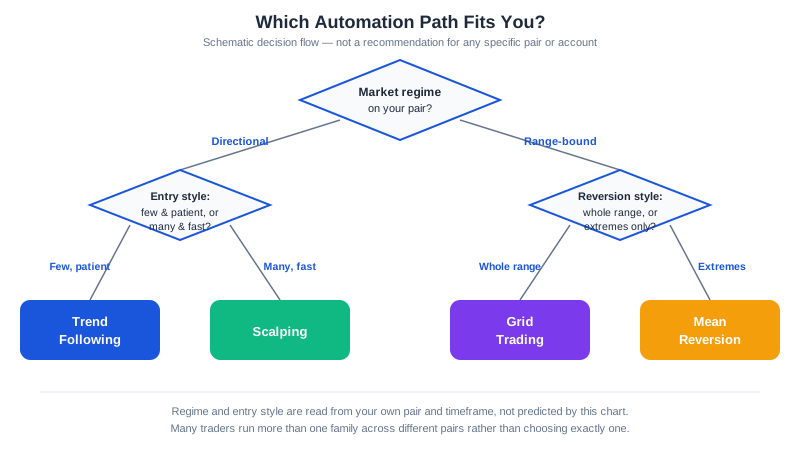
They target different market conditions, so “better” depends on what is happening. A grid needs a range to persist, a breakout needs a range to end, and a swing entry needs an established trend with a pullback inside it. Often one is working while the others sit idle.
Build on This Guide
- Grid Trading Strategy: A Rule-Based Blueprint — the range-bound complement
- Breakout Trading Strategy: A Rule-Based Blueprint — a range’s end, not a trend’s pullback
- Forex Risk Management Guide — stop distance into position size
- Swap-Free (Islamic) Forex Accounts Explained — the overnight-cost alternative
- Backtesting Guide — testing a written rule first
- DualHorizon EA — a multi-timeframe trend EA built on this structure
This article is for educational purposes only and does not constitute financial advice. Price markers such as pullback_low and pullback_high are schematic notation, not quotes or forecasts. Trading forex carries significant risk of loss, and most retail traders who trade forex and CFDs lose money — XM’s own risk disclosure states that 75.12% of retail investor accounts lose money trading CFDs with that provider, as published by XM in its regulatory risk disclosure, August 2026. Past performance is not indicative of future results. Full disclaimer