What Is Swap, and Why Does It Exist?
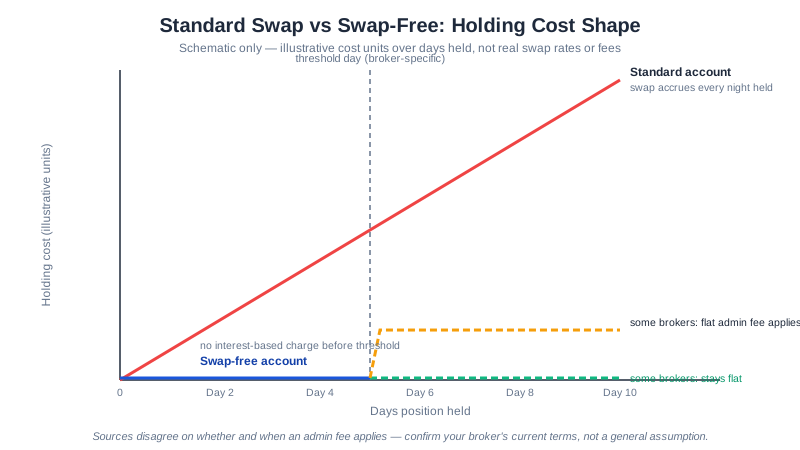
Every leveraged forex position is, mechanically, a loan: you are borrowing one currency to buy another. Hold that position past your broker’s daily rollover cutoff — commonly around 5pm New York time — and the broker applies swap, an interest adjustment based on the difference between the two currencies’ interest rates. Depending on which currency you are long and which you are short, swap can be a small credit or a small debit, applied once for every night the position stays open.
Because currency markets settle on a T+2 basis, a position held through Wednesday’s rollover typically has the weekend rolled into that single charge — brokers commonly apply what the industry calls a “triple swap” on Wednesday to account for the two non-trading days ahead. This is standard mechanics across conventional retail accounts, not a fee unique to any one broker, and it is the specific mechanic that swap-free accounts exist to remove.
For a trader who closes every position the same day, swap is close to irrelevant. For anyone running a grid EA that can hold several positions open across days, or a swing strategy that deliberately carries trades overnight, swap is a real, recurring cost that compounds with holding time — which is exactly the population this account type is built for.
What Should I Check Before Assuming an Account Is Swap-Free?
| Criterion | What to Check | Why It Matters |
|---|---|---|
| Eligibility | Whether the broker requires proof of religion or nationality | Most brokers open swap-free status to any client on request, not a verified religious status |
| Activation | Whether it’s an opt-in toggle or a support request, and typical approval turnaround | It is generally not automatic — you must actively request it after opening a standard account |
| Admin-fee model | Whether a flat administration fee applies once a position is held past a threshold number of days | Determines whether “swap-free” is genuinely cost-free for longer holds, or just interest-free |
| Instrument restrictions | Which instruments are covered (spot forex majors/minors, sometimes metals) versus excluded (index, commodity, or share CFDs) | Excluded instruments may still carry a separate fair-value adjustment even on a swap-free account |
| Holding-period limits | Any maximum holding duration or day-count tied to the admin-fee threshold | Directly affects grid or swing EAs that hold positions across multiple days |
| Anti-abuse review | Whether the broker reserves the right to review or revoke swap-free status for certain trading patterns | Status is not always a permanent, unconditional grant once activated |
How Does a Swap-Free Account Actually Replace the Cost?
A swap-free (sometimes “Islamic”) account does not simply waive overnight charges; it restructures how the broker recovers the cost of the overnight financing. The Islamic prohibition on riba (interest) is the reason the product exists, but in practice brokers implement it in one or more of these ways:
- No overnight interest charged or credited — the core feature, applied instead of the standard swap calculation.
- A flat administration fee on positions held past a threshold number of days, replacing interest with a fixed charge that is (in principle) not interest-based.
- A wider spread or a small fixed commission applied broadly, recovering the cost structurally rather than per night.
- Instrument restrictions — swap-free status commonly applies to spot forex majors and minors, and sometimes metals, but may exclude or apply different terms to CFDs on indices, commodities, or shares.
Which combination applies depends entirely on the individual broker, and — importantly for this guide — sources disagree even on well-documented brokers about the specifics. One broker-comparison summary states plainly that a specific broker “does not charge admin fees or spread markups on Islamic accounts for forex pairs” (as reported by tic.co.tz, updated June 2026); other 2026 broker-comparison sources describe swap-free accounts more generally as carrying “a small admin fee [that] may apply after certain days.” We are not going to resolve that disagreement here, because we can’t verify it from a single authoritative source — the honest takeaway is that “swap-free” is not synonymous with “free of every overnight-related cost.” Read the specific terms document for the account you open, not a summary of it.
Who Qualifies for a Swap-Free Account, and How Do You Get It?
Contrary to what the name suggests, eligibility is typically not restricted by nationality or religion. Broker-comparison sources describe brokers accepting swap-free account requests from clients in Muslim-majority markets — including Pakistan, Indonesia, Nigeria, and others — but generally without requiring proof of religious affiliation (as reported by tic.co.tz, updated June 2026). The usual process is:
- Open a standard trading account (Micro, Standard, or equivalent) through the broker’s normal KYC flow.
- Request swap-free status specifically — this is commonly an opt-in toggle or a support request, not automatic.
- Wait for the broker to process the request, which some sources describe as being handled within roughly a day, though this varies by broker.
Because it is opt-in and not the default, a trader who wants swap-free trading has to actively request it — simply being in an eligible country does not switch the account type automatically.
What Conditions and Limitations Come With Swap-Free Status?
Does an Administration Fee Kick In After a Holding Threshold?
This is the condition most worth checking before you rely on a swap-free account for a long-hold strategy. Industry sources describe brokers applying an admin fee once a position has been held open for a threshold number of days — a figure some sources put at around five days for some brokers — as a mechanism to prevent swap-free status from being used purely to avoid the time-value cost of holding a position indefinitely. Other sources, describing the same broker, report no such fee on forex majors specifically. Given that disagreement, treat any specific day-count threshold you read as unverified until you confirm it on the broker’s own current terms page for the account you actually hold.
Does Swap-Free Cover Every Instrument?
Swap-free status is generally strongest on spot forex pairs and sometimes precious metals. Instruments with genuine time-based costs baked into their pricing — commodities, index CFDs, and some share CFDs — more commonly carry a separate “fair value adjustment” or similar charge even on a swap-free account, because those instruments have real underlying carrying costs that a broker cannot simply waive without repricing the instrument itself.
Can a Broker Revoke Swap-Free Status Later?
Several sources note that brokers reserve the right to review or revoke swap-free status if an account’s trading pattern looks like it exists purely to exploit the fee structure — for example, systematically holding positions to collect the swap-free benefit on strategies that would otherwise be uneconomical once real interest costs applied. This is a broker risk-management clause more than a routine trader concern, but it means swap-free status is not always a permanent, unconditional grant once activated.
Does Swap-Free Trading Matter for EAs That Hold Overnight?
This is where the account type stops being a religious-compliance detail and becomes a cost-and-risk decision relevant to anyone running certain kinds of automated strategies.
A single trend-following EA that enters and exits within a session is largely indifferent to swap — it rarely holds anything through a rollover. A grid trading EA, by contrast, is structurally built to hold multiple simultaneous positions, sometimes across several days, while it works a drawdown or waits for price to return to a profitable zone (see grid trading vs martingale for how that holding pattern drives risk). On a standard account, every one of those positions accrues swap independently, every night it stays open — and a losing streak that stretches into a multi-day drawdown compounds swap cost on top of the price risk already being managed.
Swap-free status removes the interest component of that stack, which is a genuine benefit for a strategy like this — but per the section above, it does not necessarily remove every overnight-related charge, and a grid EA is precisely the strategy type most likely to run into an administration-fee threshold if one applies, simply because it holds positions longer and more often than a single-entry strategy does. Before running a grid EA like GridMaster on a swap-free account expecting zero holding cost, confirm the specific broker’s current terms — not a generic assumption that “swap-free” means “cost-free.”
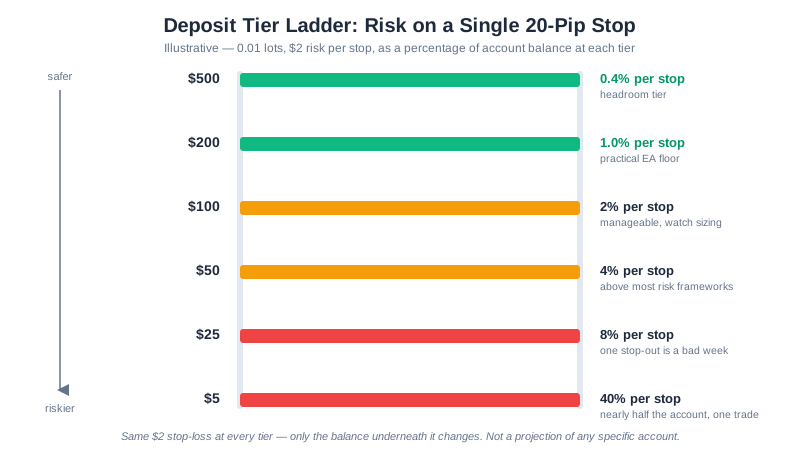
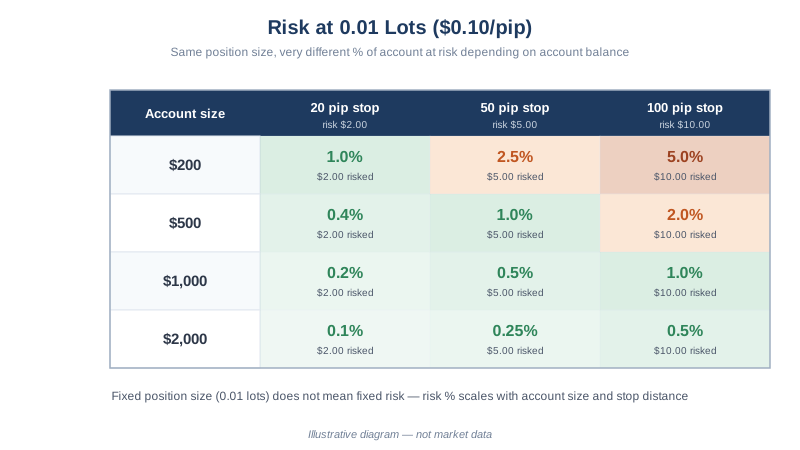
None of this changes the underlying price risk. Swap-free status addresses one line item in a strategy’s cost structure; it does not reduce drawdown risk, and it is not a substitute for the position-sizing and drawdown limits covered in our risk management guide. Our own EAs’ backtested results, where holding periods and any applicable costs are already reflected, are published on the performance page — treat those as backtested and hypothetical, not a guarantee of what any specific account will produce.
Does Swap-Free Status Mean Market Risk Goes Away?
It is worth stating plainly, because the name invites the confusion: a swap-free account changes how one specific cost is charged. It does not reduce market risk, does not improve a strategy’s win rate, and does not protect a small account from drawdown. Most retail traders who trade forex and CFDs lose money — a base rate every broker’s own risk disclosure confirms in some form, and that fact is unrelated to which account type or fee structure you trade under. Choose a swap-free account because your strategy genuinely holds overnight and the interest-based cost or compliance requirement is real for you, not because “free” in the name implies anything broader.
Check XM's swap-free account options if that fits your strategy — and read the specific terms for your entity and instrument list before assuming any of the general conditions above apply exactly as described.
Frequently Asked Questions
What is a swap-free (Islamic) forex account?
An account type that replaces the interest charged or paid on positions held overnight with a structure that does not involve interest, so it complies with the Islamic prohibition on riba. Most brokers implement it as an opt-in variant of their standard account types rather than a separate product, and it is typically open to any trader, not verified by religion.
Do I have to be Muslim to open a swap-free account?
No. Brokers generally do not verify religion or require documentation beyond standard account-opening KYC; the account type is usually available to any client who requests it. Some brokers reserve the right to review or revoke swap-free status if an account shows patterns consistent with exploiting the fee structure rather than genuine overnight holding needs.
Is a swap-free account completely free of overnight costs?
Not necessarily. Removing interest-based swap does not guarantee zero cost — sources disagree on whether and when brokers apply a flat administration fee after a position has been held for a set number of days, and terms vary by broker and by instrument. Read the specific broker’s swap-free terms before assuming a long-held position is cost-free.
Does swap-free trading matter for EAs?
It matters most for EAs that routinely hold positions overnight or for multiple days, like grid and swing strategies. A single day-trading EA that closes everything before the rollover cutoff is largely unaffected either way. A grid EA managing several simultaneous positions across a multi-day drawdown is exactly the case where swap costs — or their replacement fee — compound the most.
Recommended Reading
- What Is Grid Trading? — the strategy type most affected by overnight holding costs
- Grid Trading vs Martingale — how multi-day drawdowns compound risk
- GridMaster Setup Guide — settings for a grid EA that holds positions across days
- Forex Risk Management Guide — the position-sizing discipline swap-free status does not replace
- XM Broker Review — regulation, entities, and account types referenced above
Affiliate Disclosure: this page contains affiliate links. We are an XM Introducing Broker and are paid when you open an account through them. Full disclosure.
Risk Warning: trading forex and CFDs on margin carries a high level of risk and may not be suitable for all investors. Account type and fee structure do not reduce market risk. Only trade with money you can afford to lose. Read our risk disclosure.