The Myth: “Minimum Deposit” Means “Minimum to Trade”
Forex brokers advertise a minimum deposit because a low number is good marketing. XM’s published minimum, for example, is $5 across its Micro, Standard, and Ultra Low accounts (as published by XM, August 2026). Read quickly, that headline implies $5 is a workable starting point. It isn’t — it’s an account-opening threshold, and the gap between “opens an account” and “trades in a way that survives a losing streak” is wide enough to matter, especially for readers funding accounts from Nigeria, South Africa, Pakistan, Indonesia, or Turkey, where a “large” trading balance is often measured in tens rather than thousands of dollars.
This guide works through that myth and five smaller ones that follow from it, checking each one against the arithmetic a minimum deposit actually produces — not against how it’s marketed. Along the way it separates what a deposit technically buys from what balance actually lets you trade, manually or with an Expert Advisor.
Myth 1: $5–$50 Is Enough to Start “Small”
A trading account balance converts into market exposure through lot size. The smallest position most retail brokers allow is 0.01 lots — a micro lot, worth 1,000 units of the base currency. On a US-dollar-quoted pair, that makes one pip worth roughly $0.10 (see lot sizes explained for the full arithmetic and why it changes on JPY and cross pairs, or the pip-value calculator to check a specific pair directly).
That $0.10-per-pip floor is the real constraint, not the headline deposit figure. Work it backward:
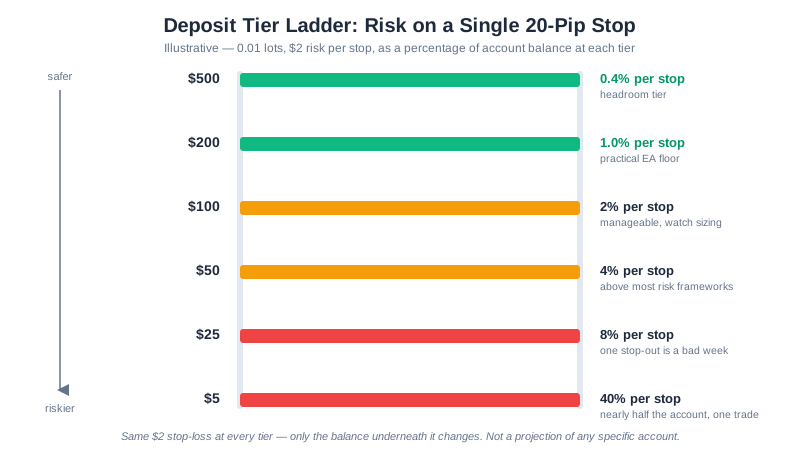
| Deposit | Position at 0.01 lots | Risk on a 20-pip stop | Risk on a 50-pip stop | % of balance (20-pip stop) |
|---|---|---|---|---|
| $5 | 0.01 lot | $2.00 | $5.00 | 40% |
| $25 | 0.01 lot | $2.00 | $5.00 | 8% |
| $50 | 0.01 lot | $2.00 | $5.00 | 4% |
| $100 | 0.01 lot | $2.00 | $5.00 | 2% |
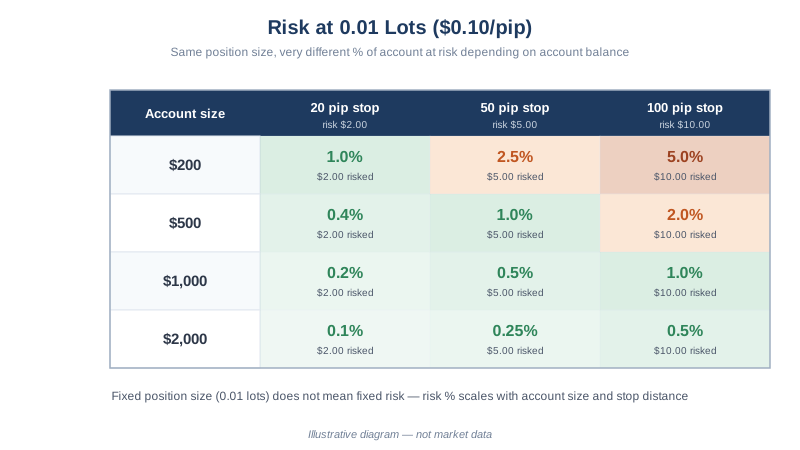
The position size does not shrink below 0.01 lots no matter how small the deposit is — that floor is set by the broker’s trading platform, not by your risk plan. So the deposit doesn’t just fund the trade; it determines what percentage of the account a single minimum-size stop-loss consumes. At $5, one ordinary stop-out is nearly half the account. At $100, the same stop is a manageable 2%. Nothing about the strategy changed between those two rows — only the capital behind it did.
Fact: a $5–$50 deposit opens an account. It doesn’t fund a stop-loss that behaves like a normal, absorbable loss — it funds one that can end the account in a handful of trades, regardless of how sound the strategy behind it is.
Myth 2: Any Account Type Works the Same at a Small Balance
Most brokers offer at least two account types, typically labeled Micro and Standard (sometimes with a third, lower-spread tier like XM’s Ultra Low). The difference that matters at small balances is contract size:
| Account type | Contract size (1.00 lot) | Smallest position | Pip value at smallest position (USD pairs) |
|---|---|---|---|
| Micro | 1,000 units | 0.01 lot | ~$0.10 |
| Standard | 100,000 units | 0.01 lot | ~$0.10 |
On paper the smallest tradeable position looks identical across account types, because both floor out at 0.01 lots. The practical difference shows up if you ever need a position smaller than that floor to keep risk proportional to a small balance — some micro accounts allow fractional sizing below 0.01 lots on certain platforms, which standard accounts typically do not. If your working capital is under roughly $200, defaulting to whichever account type your broker labels “Micro” avoids one class of sizing problem; above that, the distinction stops mattering much, and spread and commission structure become the more relevant choice (see understanding spreads and commissions).
Fact: at small balances, Micro is the safer default — its smaller contract size (1,000 units per 0.01 lot versus 100,000) is what lets the position-sizing math work at all. Standard only becomes the equivalent choice once the balance is large enough that 0.01 lots is already a small fraction of it.
Myth 3: More Leverage Helps a Small Account Trade Bigger
High leverage is often marketed as an advantage of small-account trading — “control a full lot with almost nothing down.” That framing inverts what leverage actually does. Leverage does not raise expected return; it changes how much capital stands between an ordinary price move and a margin call.
As published by XM (July 2026), offshore-regulated entities can offer leverage up to 1:1000, while regulated entities under CySEC or comparable regulators cap retail leverage near 1:30 for major pairs (figures verified in our XM broker review). See forex broker regulation explained for why that gap exists across licence tiers and what it means for the protections behind your deposit. The arithmetic behind that gap:
| Leverage | Margin required, 1 standard lot EUR/USD | Approx. adverse move that consumes it |
|---|---|---|
| 1:30 | ~$3,333 | Far larger than a typical daily range |
| 1:100 | ~$1,000 | A large but plausible daily range |
| 1:500 | ~$200 | A routine intraday swing |
| 1:1000 | ~$100 | A 10-pip move |
At 1:1000, a 10-pip adverse move — well inside normal intraday noise on a major pair — can consume the entire margin behind a standard lot. High leverage on a small account does not make the account more capable; it makes the same dollar move capable of doing proportionally more damage, faster. Regulated entities cap retail leverage near 1:30 for exactly this reason. If your account is small, the honest use of leverage is to size positions the same way you would on a larger account (fixed percentage risk per trade, see our risk management guide) and treat the available leverage ceiling as something you never approach.
Fact: leverage doesn’t change expected return; it changes how much of an ordinary price move it takes to hurt you. On a small account, more of it is a bigger fuse, not a bigger engine.
Myth 4: A Good Strategy Will Always Survive a Losing Streak on Any Balance
Every trading strategy has losing streaks; that is not a flaw in the strategy, it is how probability works. The question a small account has to answer honestly is whether it has enough headroom to survive one.
Take a $100 account trading 0.01 lots with a 30-pip stop, risking $3 per trade — a reasonable 3% per trade at that balance, already above the 1-2% most risk frameworks recommend. Six consecutive losses, well within normal variance for most strategies over a few dozen trades, would draw the account down roughly 18%, before recalculating position size downward as the balance falls (see the streak arithmetic in our risk management guide). A $500 account risking the same 1-2% per trade absorbs the same losing streak as a much smaller percentage move, with room to keep trading at a sustainable size afterward.
The pattern holds generally: smaller balances need smaller percentage risk per trade, not larger, to have equivalent headroom — which usually means the achievable position size at very small balances is dictated by the 0.01-lot floor rather than by your intended risk percentage. That mismatch is the core problem with trading a $5–$50 account at all, independent of strategy quality.
Fact: headroom scales with balance, not with how good the strategy is. A $500 account absorbs the same losing streak as a much smaller percentage move than a $100 account does — the strategy did nothing different in either case.
Myth 5: An EA Will Just Handle Small-Account Sizing for You
An Expert Advisor sizes positions from a configured risk percentage and the account’s current balance. That formula does not know your balance is small; it simply computes a lot size, and when that computed size falls below the 0.01-lot broker minimum, one of two things happens: the EA skips the trade, or it takes 0.01 lots anyway at an effective risk well above what was configured. Neither is a bug — it is the sizing floor showing up in practice, and it is exactly what happens whether or not the EA’s marketing mentions it.
Our own guidance, consistent across the XM deposit guide and lot sizes explained, treats roughly $200 as the practical floor for a single conservative EA — a floor, not a comfortable number — with $500+ giving real headroom to survive a losing streak without breaking risk sizing. That figure is not specific to one EA — it falls out of the same 0.01-lot arithmetic covered above, applied to typical ATR-based stop distances on H1 majors.
EA type matters too. A single trend-following EA managing one position at a time fits a smaller balance more comfortably than a grid EA that can open several simultaneous positions — grid strategies need enough capital to absorb multiple concurrent stops, not just one (see grid trading vs martingale and the GridMaster setup guide, which uses the same $200 floor for its smallest preset). Whatever the EA, published backtest results for our EAs are on the performance page as backtested, hypothetical results — not a projection of what a specific account balance will earn.
Fact: roughly $200 is the practical floor for running a single conservative EA sensibly, not the advertised $5 minimum — and that number comes from the same lot-size arithmetic as every other myth on this page, not from a separate rule.
The Fact Pattern: What a Sensible Small-Capital Plan Looks Like
None of this is an argument against trading with limited capital — it’s an argument against treating the advertised minimum deposit as the number that matters. A workable plan for a trader starting with $50–$200 looks like this:
- Open a Micro account, not Standard, so the sizing floor works in your favor rather than against it.
- Treat $200 as the entry point for live automated trading, and use a demo account below that to learn the platform and test settings without capital at risk.
- Never size up to “use” available leverage. Compute position size from a fixed risk percentage and stop distance, and let the leverage ceiling sit unused.
- Add to the account to extend headroom, not to rescue a drawdown. Capital added after a losing streak to keep a position open is a different, worse decision than capital added on a fresh deposit.
Most retail traders who trade forex and CFDs lose money — XM’s own risk disclosure states that 75.12% of retail investor accounts lose money trading CFDs with that provider (as published by XM, August 2026, quoted in full in our XM broker review), and comparable brokers publish comparable figures. A small account does not change that base rate; it mainly narrows the margin for sizing mistakes, which is why the arithmetic in this guide matters more, not less, when capital is limited.
Open a free XM account if you want to test this arithmetic yourself — start on demo, and only fund it with money you can afford to lose.
Go Deeper
- Forex Lot Sizes Explained — the pip-value math behind every table above
- How to Fund Your XM Account — deposit methods and the $200 practical floor
- Forex Risk Management Guide — streak arithmetic and position sizing methods
- Best Forex Pairs for Small Accounts — pairing limited capital with the right instruments
- Demo Account Guide — practicing sizing without risking capital
Affiliate Disclosure: this page contains affiliate links. We are an XM Introducing Broker and are paid when you open an account through them. Full disclosure.
Risk Warning: trading forex and CFDs on margin carries a high level of risk and may not be suitable for all investors. You could lose some or all of your invested capital. Only trade with money you can afford to lose. Read our risk disclosure.