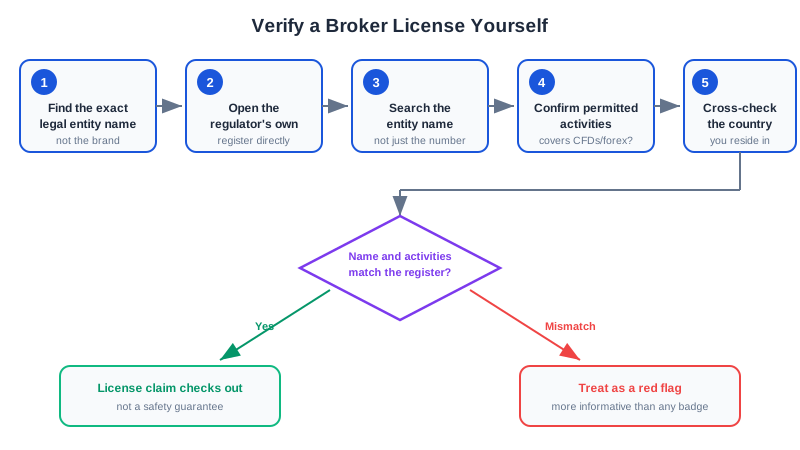
A licence badge on a broker’s homepage is marketing copy until you check it — an image file the broker controls, not evidence. What actually proves the claim is the regulator’s own public register, built specifically so anyone can look a firm up without asking permission. This guide walks through five registers you’ll run into most often — FCA, ASIC, CySEC, FSCA, and NFA — with the exact page, what to search, and what a genuine result looks like, so you can run the check yourself in a few minutes.
This is a companion to our broader broker regulation explainer, which covers what each licence tier actually protects. This page is narrower: it’s about operating the lookup tools themselves.

Before You Search: Get the Exact Legal Entity Name
Every register below is searched by legal entity name, not brand. “XM” or “IC Markets” is marketing; the register only knows the company that applied for the licence — usually something like “[Company] Ltd” or “[Company] Pty Ltd.” Find it in the broker’s footer, its “legal documents” section, or the client agreement, in a line like “operated by [Company Name], authorised by [Regulator].” Write that exact string down first — searching the brand name alone is the most common way people convince themselves a check passed when it didn’t.
The FCA Register (United Kingdom)
The UK’s Financial Conduct Authority runs the Financial Services Register at register.fca.org.uk, the authoritative record of every firm and individual the FCA has authorised. For a quicker entry point, the FCA also offers the FCA Firm Checker, which confirms whether a firm is authorised and holds permission for the services it’s offering, as published by the FCA, checked 24 August 2026.
Search the legal entity name (or its Firm Reference Number) and look for the authorisation status, the permitted activities (a firm can be authorised for one activity and not for retail forex or CFDs), and, on the full register only, historic fines and restrictions. The FCA notes Firm Checker data can lag the full register by up to roughly 24 hours, as published by the FCA — for anything time-sensitive, check the full register directly.
ASIC’s Professional Registers Search (Australia)
Australia’s Securities and Investments Commission publishes a Professional Registers search for checking whether an organisation is licensed to provide a financial service, reachable from ASIC’s online registers search page. ASIC’s consumer site, Moneysmart, directs the public to this same tool on its “Check before you invest” page as the way to confirm an Australian Financial Services Licence (AFSL), as published by ASIC/Moneysmart, checked 24 August 2026.
Search the entity name and confirm an AFSL number is attached to that exact legal name, and that it’s current rather than lapsed or cancelled. Moneysmart is explicit that holding an AFS licence “doesn’t mean that ASIC endorses the company” — it confirms authorisation, not safety. It’s also worth knowing this checks whether an entity is licensed at all, not whether it’s licensed to serve you: brands have kept an AFSL live in the corporate group while no longer accepting Australian residents, so a hit on the register isn’t the same as confirming the entity in front of you is the one holding it.
CySEC’s Regulated Entities List (Cyprus)
The Cyprus Securities and Exchange Commission publishes its Cypriot Investment Firms list at cysec.gov.cy/en-GB/entities/investment-firms/cypriot/. Unlike the FCA and ASIC tools, it isn’t a search box — it’s a static, alphabetical list (with an Excel download) republished as a dated snapshot; the version live at time of writing carried the header “CIF Regulated Entities List as of 04 May 2026,” as published by CySEC, checked 24 August 2026.
Use your browser’s find function for the entity name and check its entry for the licence number and date (format like “435/23”), any approved trade names (useful for matching a marketing brand to its licensed entity), and status notes — annotations like “(voluntary suspension)” flag a firm that’s licensed on paper but not fully operating under that licence right now. Because it’s a snapshot, re-check the live list rather than trusting a cached copy from a third-party site.
FSCA’s FSP Search (South Africa)
South Africa’s Financial Sector Conduct Authority (FSCA) offers a search for Financial Services Providers (FSPs) linked from fsca.co.za under a “FSP Search” option, as published by the FSCA, checked 24 August 2026. Search by the FSP’s registered company name or its FSP number — searching by number, when a broker publishes one, is faster and more exact.
The status field is the whole check: Authorised is the only status meaning the FSP can currently service clients; Suspended or Cancelled means it can’t, regardless of what the marketing pages claim. Confirm the registered name on the result matches the entity in the client agreement, not just a similar-sounding brand.
NFA BASIC (United States)
The National Futures Association’s BASIC (Background Affiliation Status Information Center), at nfa.futures.org/basicnet/, is the free tool for checking NFA membership and CFTC registration status for any firm dealing in US retail forex, as published by the NFA, checked 24 August 2026. Search by firm name or NFA ID number; a result shows current and historical registration status plus any regulatory or disciplinary actions from the NFA, CFTC, or US futures exchanges.
This matters more than it looks for US readers specifically: retail forex in the US can only be legally offered by an NFA member registered as a Forex Dealer Member (FDM) — a narrower bar than “regulated” elsewhere. A firm marketing to US residents that doesn’t turn up as a current FDM is failing the core requirement, not a minor formality. The NFA also points users to FINRA’s BrokerCheck for licensing that extends into securities, since BASIC’s scope stops at NFA/CFTC activity.
Cross-Checking the Result
A result from any of these five tools falls into one of three outcomes: match, current, and in scope — the name matches, status is active, licensed activities cover what’s being offered, which is what “verified” should mean; no match — try a close variant of the legal suffix, but treat a genuine miss as a hard red flag, not a search error; or match, but lapsed, suspended, or out of scope — the entity exists but isn’t currently authorised for what’s on offer, the outcome people miss most because they stop reading once a name appears at all.
None of these registers make a safety judgment — they confirm authorisation, not investment quality or whether your money comes back on request. And regulation doesn’t change the underlying odds: most retail traders who trade forex and CFDs lose money, a figure regulated brokers must disclose themselves — XM discloses that 75.12% of retail investor accounts lose money trading CFDs with it, as published by XM in its regulatory risk disclosure, cited August 2026. A clean result tells you the firm is who it says it is and is allowed to offer what it’s offering; it doesn’t tell you the trade will work out.
For what each licence tier actually covers once you’ve confirmed a firm holds one — compensation schemes, leverage caps, complaint escalation — see our broker regulation explainer next, and our XM broker review for a worked example against a specific brand’s multiple entities. Open a free XM account only after confirming which entity you’d be onboarded to and checking its register status yourself.
FAQ
Is a broker’s licence number on its own website proof of regulation?
No. A licence number printed on a broker’s marketing page is a claim, not evidence. Numbers get copied forward for years after an entity is renamed, sold, or has its licence lapse or get revoked. The only way to confirm a claim is to type the regulator’s own domain into your browser and search their register directly, never a link the broker itself provides.
Which regulator’s lookup tool should I use if a broker lists several licences?
Use the one for the entity you would actually be contracted with, which depends on your country of residence, not the badge that caught your eye. A single brand often runs several legal entities, each licensed somewhere different. Find the exact legal entity name in the broker’s account-opening documents first, then search that name on the matching regulator’s register.
What does it mean if a broker’s entity doesn’t appear on any regulator’s register?
It means that entity is not currently authorised by that regulator, which is a serious red flag, not a technicality. A firm can be registered as a company (able to legally exist) without being licensed to provide investment or forex services. Treat a missing or lapsed register entry as more informative than anything on the broker’s own site.
Do the FCA, ASIC, CySEC, FSCA, and NFA registers cost money to use?
No. All five are free, public tools maintained by the regulator itself. None of them require an account, a login, or payment to search a firm or pull up its status.
Further Reading
- Forex Broker Regulation Explained: What License Tiers Mean — what each protection (segregated funds, compensation scheme, leverage cap) actually covers, by tier
- XM Broker Review 2026 — a worked example of checking a specific brand’s multiple regulated entities
- How to Choose a Forex EA in 2026 — what to verify beyond regulation before trusting automated trading
- Minimum Deposit Forex Brokers — how entity and regulation tier interact with deposit minimums
This article is for educational purposes only and does not constitute financial advice. Regulator registers and lookup tools change their URLs and interfaces over time; if a link above no longer resolves, search the regulator’s own domain directly. Full disclaimer