How to Choose a Forex EA in 2026
There are thousands of forex Expert Advisors for MT4 — and most of them lose money. The difference between an EA that compounds steadily and one that blows your account in a month is rarely luck. It comes down to running every candidate through three gates before risking a single dollar: an instant-reject red-flag screen, a six-point shortlist check, and a 30-day demo test that has to agree with the backtest before you go live.
Skip the guesswork: All seven of our free MT4 & MT5 EAs publish their full strategy logic and risk caps — download them free →
If you’re new to Expert Advisors entirely, start with what a forex EA is and how it works, then come back to this checklist.
Quick Answer
Choose a forex EA by running it through three gates, in order. Gate 1 rejects on sight: no stop loss, “secret” or “AI” logic with zero documentation, screenshots instead of verified results, guaranteed-profit language, pressure tactics, or no demo version — any one of these ends the evaluation. Gate 2 shortlists what survives against six criteria: documented logic, a 5+ year 90%+-quality backtest with realistic spread and 200+ trades, modest rather than spectacular return claims, hard drawdown control, a trading style that fits your account size, and a broker that permits that style without restriction. Gate 3 is a minimum 30-day demo forward test spanning at least one high-impact news event — only an EA whose demo behavior matches its backtest earns real money, and even then it starts at the smallest allowed lot size.
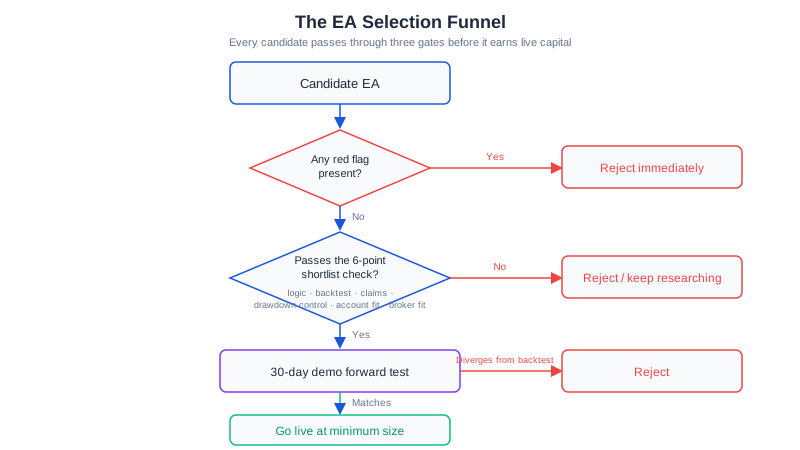
SteadyPips requires a backtest of at least five years at 90%+ modelling quality, with 200+ trades and a realistic 1–2 pip EUR/USD spread, before an EA is considered — followed by a minimum 30-day demo forward test spanning one high-impact news event (SteadyPips EA selection checklist, as of August 2026).
Gate 1: Reject on Red Flags First
Run this screen before you read a single backtest number. Any one of these is enough to end the evaluation — there is no partial credit:
- No stop loss visible on open trades — drawdown is unbounded
- “Secret” or “AI-powered” logic with zero documentation
- Account screenshots instead of investor-password-verified results
- Guaranteed profit language — no legitimate vendor uses it
- Pressure tactics (“price doubles tomorrow”, “only 7 copies left”)
- No demo version available — you’re expected to trust, not verify
One red flag is enough. There are too many transparent EAs available — including free ones — to gamble on an opaque one. Everything that follows only applies to candidates that clear this gate.
Gate 2: Shortlist on Six Criteria
1. Demand documented strategy logic — never trade a black box
You should be able to answer one question in a sentence: when does this EA buy and sell? A legitimate EA documents its entry rules (e.g., “enters long when price breaks the 20-day high with ADX above 25”) and its exit rules. If the vendor’s answer is “proprietary AI algorithm” with no further detail, walk away. You cannot risk-manage logic you cannot see. Knowing the type of algorithm — trend-following, grid, scalping, or mean reversion — is the fastest way to tell whether the documented logic even matches how the EA is marketed.
2. Verify backtest quality, not just the equity curve
A pretty equity curve is the easiest thing in the world to fabricate. Check the test conditions instead:
| Backtest element | Minimum standard |
|---|---|
| History length | 5+ years, including 2020 and 2022 volatility |
| Modelling quality | 90%+ (tick data preferred) |
| Spread setting | Realistic (1-2 pips EUR/USD), not zero |
| Trade count | 200+ trades for statistical significance |
| Out-of-sample period | Results hold on data the EA wasn’t optimized on |
Our backtesting guide walks through running these tests yourself in MT4’s Strategy Tester — never rely solely on a vendor’s screenshots.
3. Reject unrealistic return claims
Use claim size as a filter, not as a target. Claims of 10% per month, “guaranteed profits,” or doubling your account quarterly mean one of two things: a martingale system that will eventually meet a trend it can’t survive, or fabricated results. The fastest filter in EA selection: if the promised return would make the vendor a billionaire in a decade, why are they selling it for $299? Note the inverse too — a modest, well-documented backtest is a better sign than a spectacular one, but it is still a historical figure and still no assurance you will make money.
4. Confirm hard drawdown protection
Every position should carry a stop loss, and the EA should expose a max drawdown or max-loss input that halts trading when breached. This single feature separates EAs designed to protect capital from EAs designed to look good until they don’t. Grid-based EAs deserve extra scrutiny here — see how grid trading differs from martingale and why position caps matter.
5. Match the EA to your account size and temperament
| Account size | Sensible EA style | Why |
|---|---|---|
| Under $500 | Conservative trend-following | Fewer trades, fixed stops, survives losing streaks |
| $500-$2,000 | Trend-following or tight-range grid | Enough margin for small grid baskets |
| $2,000+ | Grid or multi-strategy portfolio | Can absorb open-position drawdown safely |
A profitable EA you can’t psychologically tolerate — one that holds six open positions through a 15% drawdown — is a losing EA in practice, because you’ll switch it off at the worst moment.
If you’re starting under $500, the account-size row above is a simplification worth checking against the actual arithmetic: see minimum deposit forex brokers: what $5-$100 really gets you for how lot-size floors and drawdown headroom change what’s workable at a small balance.
This is also the honest answer to “trend-following or grid trading, which is better for a beginner?” — it depends on the account behind the question, not on which style is inherently superior. Trend-following trades less often, keeps a stop on every position, and is easier to monitor, which is why it fits smaller accounts and less experienced traders. Grid trading can produce more frequent profits in ranging markets but accumulates open positions during strong trends, which demands more capital and more experience to manage safely.
6. Check broker compatibility
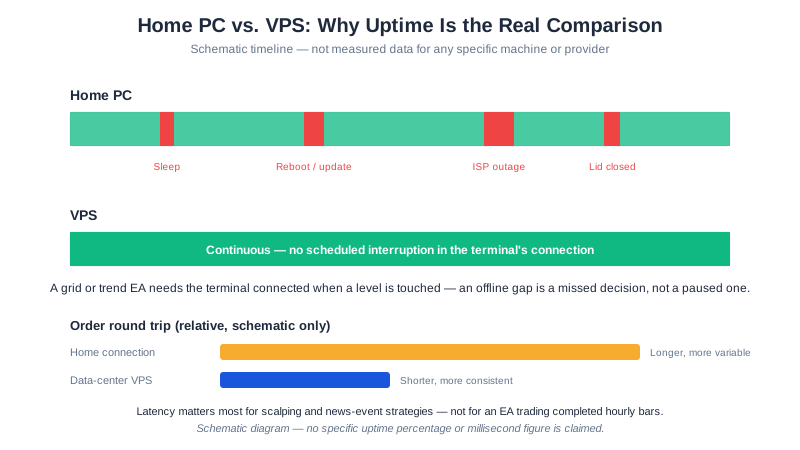
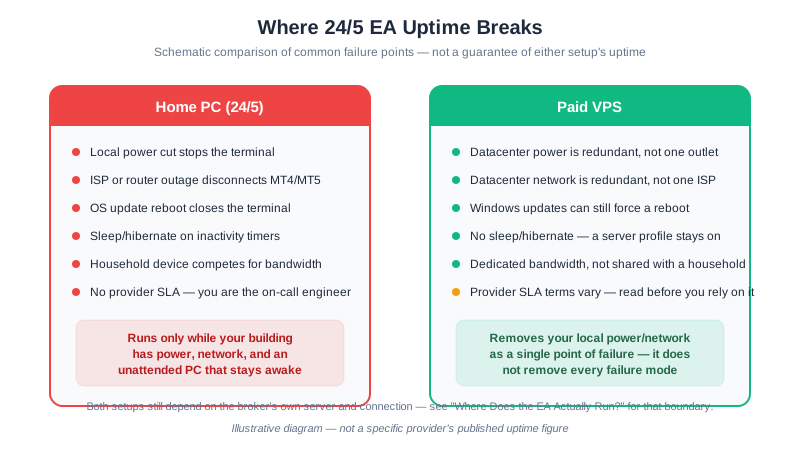
EAs need the right environment: an MT4 broker with low spreads, no restrictions on algorithmic or grid trading, and fast execution. Some dealing-desk brokers prohibit EAs outright or requote during news. We run our EAs on XM (full review) because it permits EAs and grid strategies without restriction and offers a $5 minimum deposit for safe live testing. A VPS keeps the EA running 24/5 once you go live. Whichever broker you pick, confirm what its licence actually covers rather than trusting the badge count on its homepage — see forex broker regulation explained for what each tier protects, and how to verify a forex broker’s license yourself for the regulator lookup tools and the exact fields to search.
Gate 3: Demo Test the Survivors
Backtests prove the past; forward tests prove the present. This is also where “how long should I demo test an EA before going live?” gets a firm answer: a minimum of 30 days, covering at least one major news event (NFP, CPI, or a central bank decision). That window reveals how the EA handles volatility spikes, spread widening, and losing streaks in a way a backtest can’t fully simulate.
Compare the live behavior to the backtest: similar trade frequency, similar average win/loss, no mystery trades. If the demo equity curve matches the published backtest behavior, only then go live — at the smallest allowed lot size. Our EA installation guide covers the demo setup step by step.
Free vs. Paid EAs: Does Price Predict Quality?
No — and that answers “are free forex EAs safe to use?” along the way. A free EA can be just as safe as a paid one, because safety depends on the strategy logic and risk controls, not the price tag. Price reflects marketing budget, not edge: paid EAs ($100-$1,000+) sometimes fund real development, but the marketplace is saturated with over-optimized curve-fits sold on rented Lamborghini photos. Free EAs with documented logic and visible risk caps are safer than $500 black-box robots sold with fabricated account screenshots. Free EAs span the same quality range as paid ones — the difference is you can verify them at zero cost.
The evaluation process is identical either way: documented logic → independent backtest → 30-day demo → small live allocation. A free EA that clears all three gates beats a $500 EA that fails one — and there is no reliable answer to “what’s a realistic return for a forex EA,” because many EAs lose money and no return should be treated as expected. The useful version of that question is what claim size should make you walk away, which is exactly what Gate 1 and Gate 2’s return-claims check are for.
How Our Free EAs Pass This Funnel
We built our seven free MT4 & MT5 EAs to clear exactly this funnel — documented logic, published risk caps, and realistic expectations:
| EA | Style | Best for |
|---|---|---|
| SteadyPips | Conservative trend-following | Beginners, small accounts |
| GridMaster | Range-bound grid trading | Ranging pairs like EUR/USD |
| BreakWave | Breakout momentum | Volatile sessions |
| TripleAlign | Multi-timeframe trend alignment | Patient swing-style automation |
| SnapBack | Mean reversion | Fading overextended moves on EUR/USD, GBP/USD |
| QuickPulse | Contrarian dip buying | Demo/study only — no pair currently passes our quality gate |
| DualHorizon | Multi-timeframe trend rider | Fewer, larger trend trades on EUR/USD |
All seven are free to download and run — get them here, demo test them against this funnel, and keep whichever matches your account size and temperament.
Where to Go From Here
- What Is a Forex Expert Advisor? EA Guide (2026) — the foundational primer this funnel assumes
- Types of Automated Trading Algorithms — how trend, grid, and mean-reversion logic actually differ
- Backtesting Guide: Validate Any EA Before Going Live — the data-quality traps behind Gate 2’s backtest check
- Risk Management for Automated Trading — the arithmetic behind Gate 2’s drawdown check
- How to Install an EA on MT4 — what to do once you’ve picked one
Trading forex involves substantial risk of loss. An EA automates a strategy; it does not eliminate risk. Never trade with money you cannot afford to lose.