Grid Trading EAs Compared
Comparing grid Expert Advisors on advertised returns is close to useless: a grid’s equity curve climbs in small, regular steps for as long as the market oscillates, so a clean curve mostly tells you the test window held no trend big enough to fill the ladder. What is comparable is the set of rules each vendor puts in writing. This guide turns the seven failure patterns from why grid EAs blow up into yes / no / not-published checks and applies them to five named grid EAs — including our own, which fares badly on two. Most retail forex traders lose money, and a grid EA concentrates that risk into a single basket that can stay open for weeks.
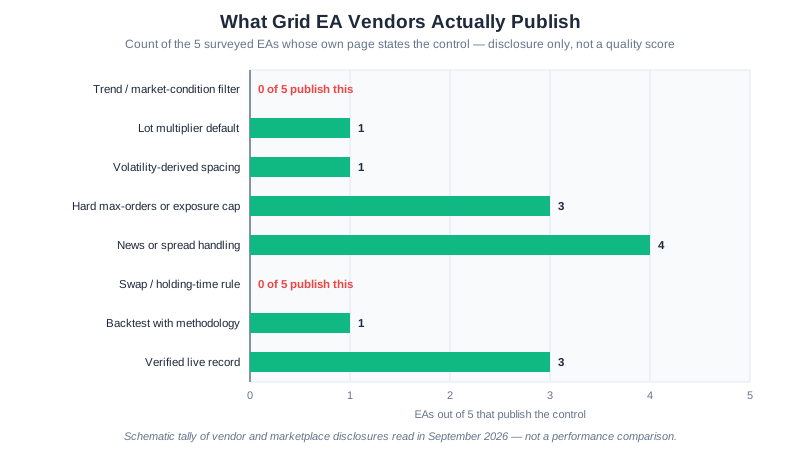
Quick Answer: Across the five grid EAs surveyed here — GridMaster, Forex Flex EA, Waka Waka EA, Grid Hero and Happy MartiGrid — eight risk-control checks produce 13 “yes” answers, 5 “no” answers and 22 “not published”. A news or spread filter is the most commonly published control (4 of 5); none publishes a trend filter or a swap and holding-time rule (0 of 5); only one publishes its default lot multiplier; three link a live record and one publishes a backtest with a stated methodology. Disclosure is not quality, but a control a vendor will not describe is one you cannot size your account against.
How We Compared
Eight checks, each a failure pattern from the blow-up guide restated as something a product page either states or does not:
- Trend / market-condition filter — a documented rule that stops new levels opening in a one-way move.
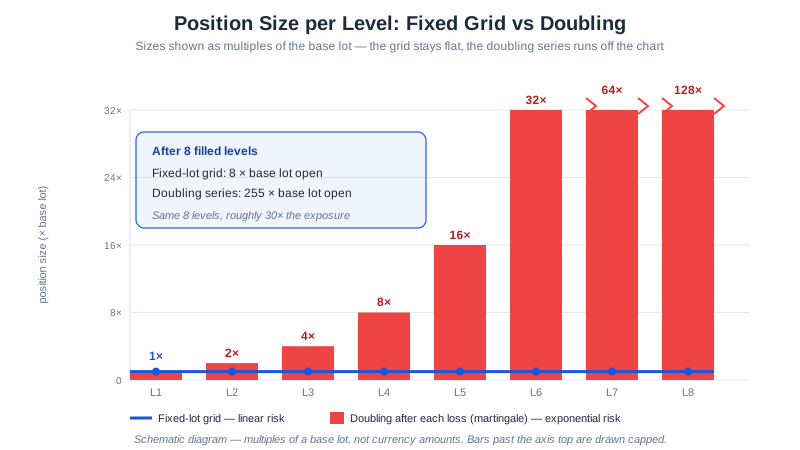
- Lot multiplier default — published, and 1.0 (flat) rather than escalating.
- Volatility-derived spacing — a step derived from measured volatility, not a fixed pip number.
- Hard max-orders or exposure cap — a software cap on positions or total lots, independent of free margin.
- News and spread handling — an event window or spread filter that blocks fills when costs widen.
- Swap and holding-time rule — a nights-open limit or weekend close for a basket that will not close in profit.
- Published backtest with methodology — figures and the data, window and cost assumptions behind them.
- Verified live record — a linked broker-verified account, not a screenshot.
Yes means the vendor’s own page states it; No means the page states the control is absent; Not published means the page is silent — the most common answer, and the reason this table exists. Each EA needed a vendor page or marketplace listing we could read and date, and every cell traces to one of the five sources beneath the table. No return, drawdown or growth figure from any vendor is repeated here as fact.
The Comparison Table
| EA | Trend filter | Lot multiplier default | Volatility spacing | Max-orders cap | News / spread | Swap / holding | Backtest + method | Verified live |
|---|---|---|---|---|---|---|---|---|
| GridMaster (ours) | No ᵃ | Yes — 1.0 ᵃ | Yes ᵃ | Yes ᵃ | No ᵃ | No ᵃ | No ᵃ | No ᵃ |
| Forex Flex EA | Not published ᵇ | Not published ᵇ | Not published ᵇ | Not published ᵇ | Yes ᵇ | Not published ᵇ | Not published ᵇ | Yes ᵇ |
| Waka Waka EA | Not published ᶜ | Not published ᶜ | Not published ᶜ | Yes ᶜ | Yes ᶜ | Not published ᶜ | Not published ᶜ | Yes ᶜ |
| Grid Hero | Not published ᵈ | Not published ᵈ | Not published ᵈ | Yes ᵈ | Yes ᵈ | Not published ᵈ | Yes ᵈ | Not published ᵈ |
| Happy MartiGrid | Not published ᵉ | Not published ᵉ | Not published ᵉ | Not published ᵉ | Yes ᵉ | Not published ᵉ | Not published ᵉ | Yes ᵉ |
Sources. ᵃ Our own GridMaster EA page and performance page, as published by SteadyPips, last updated 27 August 2026. ᵇ Forex Flex EA product site, as published by forexflexea.com (© 2026), read 21 September 2026. ᶜ Waka Waka EA MT5 listing, as published on the MQL5 Market, version 4.59 dated 8 February 2026, read 21 September 2026. ᵈ Grid Hero listing, as published on the MQL5 Market, version 9.8 dated 13 October 2018, read 21 September 2026. ᵉ Happy MartiGrid product page, as published by happyforex.de (v2.0, © 2026), read 21 September 2026.
Two patterns stand out. The controls that are cheap to advertise — a news filter, a spread filter — are near-universal, while the two that decide the shape of the loss curve, the lot multiplier and the trend filter, are almost never stated. And “not published” is not a synonym for “absent”: several of these EAs may well cap their ladders internally. It means a buyer cannot compute a worst case before funding the account, which in practice is the same problem.
GridMaster (SteadyPips)
Developer disclosure: we build and give away GridMaster, so this row is our own product and this section is not an independent review. It is in the table because leaving it out would make the comparison dishonest, and because two of its cells are the worst in the group.
What our GridMaster page publishes: LotMultiplier defaults to 1.0, so size is flat at every level and the worst case grows linearly with the level count; MaxOpenPositions defaults to 10 with a total-lots cap of 1.0; a 20% max-drawdown gate stops new orders; an equity-protection layer hard-closes everything below 70% of starting balance; CloseBeforeWeekend defaults to true; and an adaptive-spacing option derives the step from a volatility reading instead of holding 20 pips fixed. The full input sheet with ranges and defaults is on the page, which is what makes those cells answerable at all.
What it lacks: no built-in market-condition filter — the trend rule in the blow-up guide is yours to apply — and no news-event window. What it does not publish: no measured backtest table and no verified live record. Our performance page carries hypothetical backtest figures for three other EAs with the pipeline, window and cost assumptions stated, plus a July 2026 correction notice; GridMaster is not among them. On checks 7 and 8 we score worse than several paid EAs here.
The question to ask us: if the strategy is documented down to the default, why is there still no walk-forward test of it? The honest answer is that we have not run one, and until we do, the parameter sheet is a design, not a result.
Forex Flex EA
The vendor site prices Flex at “$349.47” for a single MT4 or MT5 licence, described as 67% off a regular $1,059 (as published by forexflexea.com, © 2026, read 21 September 2026). It is one of the most-searched EA names in this category, which is why it belongs in the comparison.
What the product page states: a default of “6 virtual trades per currency pair” used to monitor conditions before committing real orders; a “DD Stop loss” that closes all trades at a chosen drawdown percentage of balance; a configurable news filter that avoids “any and all high impact news events by ‘xx’ number of minutes”; and starting-balance guidance of “$10 on a nano account, $100 on a micro/cent account or $1000 on a standard account”. Live accounts are displayed on the site.
What it does not state anywhere we could read is the entry and scaling mechanics: no grid step, no maximum-orders figure, and — critically — no statement of whether lot size stays flat or escalates as a position moves against it. A drawdown stop is an equity backstop, not a cap on how large the ladder gets before it triggers.
The question to ask: what is the default lot multiplier, and does any shipped set file raise it above 1.0? Grid versus martingale explains why that single input decides whether the risk curve is linear or geometric, and why an unanswered version of this question should end the evaluation.
Waka Waka EA
Listed on the MQL5 Market at 2,800 USD, version 4.59 dated 8 February 2026, by Valeriia Mishchenko. It trades AUDCAD, AUDNZD and NZDCAD from an M15 chart and is described as an “advanced grid system” (as published on the MQL5 Market, read 21 September 2026).
This is the most complete risk-input disclosure of the four external EAs. The listing enumerates a maximum-spread filter in pips, a maximum-slippage setting, a “Maximum Drawdown Percent”, a maximum-trades limit, a stop-loss configuration, a hedging toggle, a news filter, and three lot-sizing methods (fixed, dynamic, deposit-load percentage). It gives leverage-dependent guidance — the developer advises against settings above low risk “on a less than $6000 account” at 1:30 leverage — and links a live MQL5 signal, so the history is broker-verified rather than a screenshot.
Missing is the grid geometry: no step rule, no default level count, no stated averaging factor between levels. A deposit-load percentage governs how much exposure the EA takes but not how quickly it gets there.
The question to ask: at the risk setting shown on the linked signal, how many levels can open on one pair and what total lot size does that reach? The answer determines whether the max-trades input is a real cap or a number far above where margin runs out.
Grid Hero
Listed on the MQL5 Market at 499 USD, version 9.8 dated 13 October 2018, by Chock Hwee Ng, recommended for EURUSD on H1, with a stated minimum deposit of “$4000 USD” (as published on the MQL5 Market, read 21 September 2026).
Grid Hero is the only EA here that publishes a backtest with a described methodology: the listing cites “13 years back test of real tick data” covering 2004–2017, a Monte Carlo robustness test with 2,000 simulation runs, and a delayed-slippage test. That is why its check-7 cell is the only “Yes” in that column. It also publishes a news filter with an on-chart display panel, a spread filter with a max-spread-in-points input, a max-trades limit, and a balance-protection toggle.
Two dates matter more than the figures: the tested window ends in 2017 and the last version update is dated October 2018, so the published evidence describes conditions and a code base from roughly eight years before this comparison. The entry logic is named rather than described, and no lot multiplier or step is published.
The question to ask: is there any out-of-sample record after 2017 — a linked signal or a re-run on recent data? A thirteen-year backtest that stops nine years ago is the curve-fitting pattern’s natural habitat, whatever its original quality.
Happy MartiGrid
Sold from the vendor’s own site at €699 for two licences or €899 for five, version 2.0 (as published by happyforex.de, © 2026, read 21 September 2026). It is the only EA here that names its method in both the product name and the copy: a “martingale/grid strategy with technical indicators and with News filter”, with “sophisticated dynamic step and profit”. Minimum deposit is given as “Minimal deposit: 3000 USD/Cent”, and Myfxbook accounts are linked from the page.
Naming the martingale component is more transparent than the norm, and the page lists loss-control inputs — MaxLossUSD, MaxLossPerc, MaxProfitUSD, MaxProfitPerc — alongside the news filter. But the escalation itself is undefined: the multiplier, the level count it applies across, and the rule behind the “dynamic step” are all unpublished, so the only cap is a currency or percentage loss limit rather than a limit on ladder size. A loss cap enforced by closing a martingale basket realises the whole accumulated loss at once, which is a different event from a grid that simply stops adding levels.
The question to ask: what is the multiplier and the maximum level count, and at the published 3,000-unit minimum deposit, at what level does the sequence exceed free margin? If that number is not available, the minimum deposit is not sizing guidance.
What to Test Before Buying Any Grid EA
Run these before money moves, regardless of which row above looks best:
- Read the input sheet, not the sales page. An input named lot multiplier, lot factor, lot exponent, recovery mode or averaging means escalation. If the sheet is not published, treat that as the answer.
- Compute your own spacing instead of accepting the default. The calculator below applies
spacing = ADR(20) / N, floored at a multiple of your broker’s typical spread, and solves for the largest level count your equity supports — which turns a vendor’s “max trades” number into something checkable against your own account.
Grid-spacing calculator
Enter an ATR value and multiplier above to calculate spacing.
Educational tool, not investment advice. Spacing and level counts here follow the rule-based grid blueprint; verify against your own broker's spread, margin requirements, and lot step before running a live grid.
- Demo through one real trend, not one calm month. A grid looks identical in both; only the trending period reveals whether anything stops the ladder.
- Price the worst case by hand. Levels × spacing × lot size × pip value, at the EA’s own maximum, is the number the vendor should have published. If it exceeds what you can afford to lose, the configuration is wrong before it trades.
- Check broker fit. Hedging permission, micro lots and automated trading all have to be allowed; XM permits all three on MT4 and MT5.
- Work the seven failure patterns as a checklist. Why grid EAs blow up pairs each pattern with its stopping rule, and how to choose a forex EA covers the screening around it.
Grid EAs concentrate ordinary market risk into one long-lived basket, and most retail traders lose money trading forex at all. The checks above remove ways to fail; they do not add an edge.
Prices, versions and published settings are as read on each vendor or marketplace page on 21 September 2026 and change without notice — verify on the source page before buying. Nothing here is a recommendation to buy any product.
Trading foreign exchange carries a high level of risk and may not be suitable for all investors. Past performance is not indicative of future results. Grid trading strategies, including the EAs above, can produce significant drawdowns during trending markets. Always test on a demo account before trading live. Please read our risk disclosure before trading.
Affiliate Disclosure: This page contains an affiliate link to XM. We receive a commission when you open an account through our links, at no additional cost to you. Full disclosure
![Best Forex Pairs for Grid Trading: 7 Pairs Ranked [2026]](/images/charts/best-forex-pairs-for-grid-trading-ranging-vs-trending.svg)