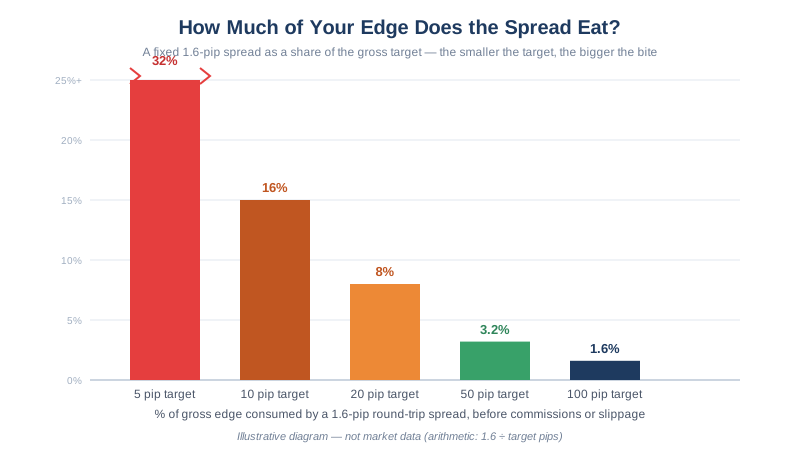
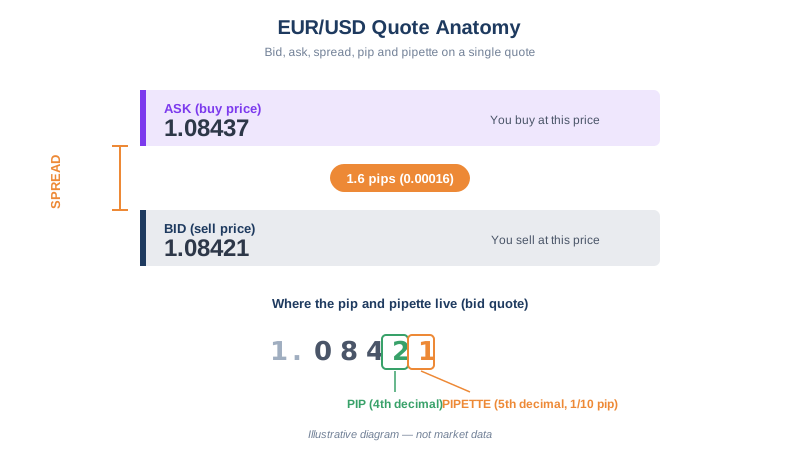
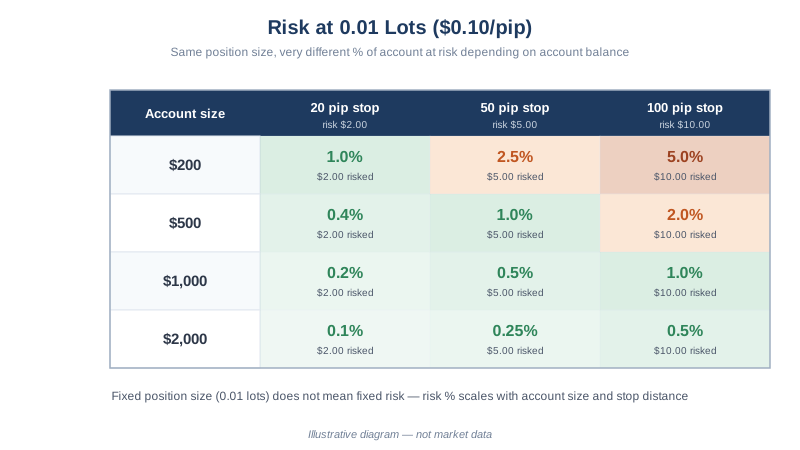
The number on a broker’s pricing page is a spread — a bid/ask gap measured in pips. It’s real, but it’s also only one line of the bill. What a trade actually costs by the time you close it depends on whether the account charges a separate commission, whether the position was held overnight, and how much slippage occurred between the price you requested and the price you got. Beginners routinely compare brokers on the spread column alone, then wonder why a “cheap” account didn’t feel cheap. This guide is the arithmetic for the full bill, not the headline number.
What “Round Trip” Actually Means
A round trip is the pair of transactions that make up one complete trade: opening a position, then later closing it. The spread is charged the instant you open — price already has to move in your favour by the spread’s width just to reach break-even — but “round trip” as a cost concept matters because some other lines are charged per leg or per day, not once:
- Spread — built into the quote, paid on entry, every trade
- Commission — a fixed per-lot fee, often charged on both legs, on raw/ECN-style accounts
- Swap — a daily charge or credit for holding overnight, scaling with nights held, not with the trade itself
- Slippage — the gap between requested and filled price, on either leg
Our spread and commission cost guide covers what each line is and how leverage regulation interacts with them; this page computes the total instead, converted into money you can check against your statement.
Anatomy of a Round-Trip Cost

The stack is ordered by certainty, not size — it’s schematic, not proportioned to real cost data. Spread sits at the bottom because it’s the one cost you can be certain of before you click “buy”: quoted, live, right now. Everything above it is conditional — commission depends on account type, swap on whether you hold past rollover, slippage on execution conditions you don’t control. A trade closed same-session on a spread-only account, in calm conditions, can genuinely be spread-only. Add any of the other three and the bill grows.
Converting Pip Cost Into Your Account Currency
Spread cost in money terms is pips × pip value × lot size, and pip value is a round number only when your account currency matches the pair’s quote currency. The lot sizes guide covers pip value by pair in full; the examples below apply that arithmetic to a round-trip spread cost.
Same-currency case: a hypothetical 1.2-pip round-trip spread on a 0.1-lot EUR/USD trade, USD account. A standard lot is $10/pip on a USD-quoted pair, so 0.1 lot is $1/pip: 1.2 pips × $1.00 = $1.20. Simple because the account currency and the quote currency are the same thing.
Cross-currency case: a hypothetical 1.5-pip round-trip spread on a 0.1-lot USD/JPY trade, GBP account, with illustrative rates USD/JPY = 150.00 and GBP/USD = 1.25 (hypothetical, for arithmetic only — not live quotes). A standard lot on USD/JPY is ¥1,000/pip, so 0.1 lot is ¥100/pip: 1.5 pips × ¥100 = ¥150. Converting ¥150 to USD at 150.00 gives $1.00, then to GBP at 1.25 gives ≈£0.80 — two conversion steps, because neither the quote currency nor the intermediate USD leg is the account’s own.
That’s the case that trips people up: pip-value tables are almost always shown against USD, and applying one to a non-USD account silently understates or overstates the real cost depending on which way the rate has moved. Use the calculator below with your account’s live figures instead of a table number, since conversion rates move every session:
Pip-value calculator
Select a pair and enter a lot size above to calculate.
Educational tool, not investment advice. Verify pip value against your broker's platform before sizing a trade.
Spread-Only vs Raw-Spread-Plus-Commission: The Structural Comparison
The two dominant account structures price the same underlying liquidity differently. A hypothetical, math-transparent comparison at 1.0 lot EUR/USD, illustrative figures only:
| Account structure | Spread | Commission | Spread cost (1.0 lot) | Total round-trip cost |
|---|---|---|---|---|
| Spread-only | 1.4 pips (illustrative) | $0 | 1.4 × $10 = $14.00 | $14.00 |
| Raw + commission | 0.2 pips (illustrative) | $7.00/lot round trip (illustrative) | 0.2 × $10 = $2.00 | $9.00 |
Here raw-plus-commission comes out cheaper at 1.0 lot, because both its components scale down together as size shrinks — a linear per-lot commission behaves like spread cost does. The comparison can flip for a different reason: some brokers apply a minimum commission per trade, charged regardless of how small the position is. Where that floor exists, a 0.01-lot trade can pay the same commission as a 1.0-lot trade, erasing a raw account’s advantage exactly where beginners trade — small size, high frequency. Check the actual commission schedule, not just the advertised per-lot rate, before assuming raw-plus-commission is cheaper at your size.
Swap: The Line That Depends on How Long You Hold
Swap is a daily charge or credit applied around the platform’s rollover time (commonly 5pm New York) for any position still open at that moment, based on the interest-rate differential between the pair’s two currencies. It’s zero for a trade opened and closed the same session, and compounds the longer a position stays open. Most MT4/MT5 brokers apply swap at roughly three times the normal rate on positions held over a Wednesday close — “triple-swap Wednesday” — to cover the weekend, when spot forex’s two-day settlement doesn’t otherwise move. That’s a standard, published mechanic, not an error, and it makes Wednesday the most expensive night to hold a swap-negative position. If the interest-based structure itself is the concern, our swap-free (Islamic) account guide covers how that account type restructures the charge, and for whom.
The actual rate is set and published per instrument by each broker and changes over time, so this guide prints no dollar figure for it — check your account’s current published overnight rate before holding past rollover, rather than trusting a number from an article.
Slippage: The Cost You Can’t Compute in Advance
Slippage is the gap between the price you requested and the price your order actually filled at. On a liquid major pair during normal hours it’s often negligible — the market has enough depth to fill a small order at or near the quoted price. It grows, and becomes less predictable, around scheduled high-impact news releases, at a session’s opening minutes after a weekend gap, and whenever a stop-loss triggers during a fast, thin move, because a market order fills at the next available price rather than a guaranteed one. There’s no published, verifiable “typical slippage” figure worth quoting here — it depends on the broker’s execution model, the instrument, and the moment — so the honest guidance is qualitative: expect it to matter most exactly when you can least predict it, and size positions with that uncertainty in mind rather than treating the quoted spread as the whole story going into a news event.
The Base Rate Underneath All of This
Getting the cost arithmetic right does not change the outcome distribution for the population trading it: 75.12% of retail investor accounts lose money trading CFDs with XM, as published by XM in its regulatory risk disclosure, August 2026 — a figure comparable regulated brokers publish in a similar range. Cost discipline narrows the drag on an edge that exists; it doesn’t manufacture one. Open a free XM account to check current published spreads and commission schedules before sizing a real trade against this arithmetic.
FAQ
What does round trip mean in forex trading?
A round trip is opening a position and later closing it — the two transactions that make up one complete trade. The spread is paid once, on entry, but framing cost as “per round trip” matters because commission is often charged on both legs, and holding the position overnight adds a swap charge that a same-session trade never sees.
Is a raw-spread-plus-commission account always cheaper than a spread-only account?
Not automatically. A tight raw spread plus a linear per-lot commission can undercut a wider all-in spread at typical trade sizes, but some brokers apply a minimum commission per trade regardless of lot size, which erodes that advantage on very small positions. The only reliable comparison is spread cost plus commission added together for your actual lot size, not the advertised spread on either account type alone.
Does slippage happen on every trade?
No. On a liquid major pair during normal trading hours, a market order is often filled at or very close to the requested price. Slippage becomes more likely, and can run larger, around scheduled news releases, at the open of a trading session after a weekend gap, or when a stop-loss triggers during a fast-moving, thin market — conditions where liquidity briefly can’t absorb an order at the last quoted price.
Further Reading
- Forex Spread & Commission Costs: The True Cost of a Trade — what each cost line is, plus how leverage regulation interacts with them
- Forex Lot Sizes Explained — pip value by pair, and the calculator this guide’s conversion examples build on
- Swap-Free (Islamic) Forex Accounts — how overnight interest is restructured, and who qualifies
- XM Broker Review — published spreads, commission schedule, and the risk disclosure this guide cites
This article is for educational purposes only and does not constitute financial advice. Trading forex carries significant risk of loss. Full disclaimer