Quick Answer: One pip is worth pip size x contract size, paid in the pair’s quote currency. For the 21 non-yen pairs in this table one pip is 0.0001 and a standard lot is 100,000 units, so a pip is worth 10 units of the quote currency per standard lot, 1 per mini lot and 0.10 per micro lot: 10 US dollars on EUR/USD, 10 francs on USD/CHF, 10 Canadian dollars on USD/CAD, 10 pounds on EUR/GBP. For the seven JPY-quoted pairs one pip is 0.01, so a pip is worth 1,000 yen per standard lot, 100 per mini and 10 per micro. Only the four USD-quoted pairs (EUR/USD, GBP/USD, AUD/USD, NZD/USD) pay their pip directly in dollars; every other row needs one exchange rate, named in the last column, to express the figure in a dollar account. This table carries no exchange rates on purpose, and most retail traders lose money trading forex however precisely they size a position.
| Pair | Pip is paid in | Pip size | Standard lot | Mini lot | Micro lot | To express in USD |
|---|---|---|---|---|---|---|
| AUD/CAD | CAD | 0.0001 | 10.00 CAD | 1.00 CAD | 0.10 CAD | divide by the USD/CAD rate |
| AUD/CHF | CHF | 0.0001 | 10.00 CHF | 1.00 CHF | 0.10 CHF | divide by the USD/CHF rate |
| AUD/JPY | JPY | 0.01 | 1000.00 JPY | 100.00 JPY | 10.00 JPY | divide by the USD/JPY rate |
| AUD/NZD | NZD | 0.0001 | 10.00 NZD | 1.00 NZD | 0.10 NZD | multiply by the NZD/USD rate |
| AUD/USD | USD | 0.0001 | 10.00 USD | 1.00 USD | 0.10 USD | already in USD |
| CAD/CHF | CHF | 0.0001 | 10.00 CHF | 1.00 CHF | 0.10 CHF | divide by the USD/CHF rate |
| CAD/JPY | JPY | 0.01 | 1000.00 JPY | 100.00 JPY | 10.00 JPY | divide by the USD/JPY rate |
| CHF/JPY | JPY | 0.01 | 1000.00 JPY | 100.00 JPY | 10.00 JPY | divide by the USD/JPY rate |
| EUR/AUD | AUD | 0.0001 | 10.00 AUD | 1.00 AUD | 0.10 AUD | multiply by the AUD/USD rate |
| EUR/CAD | CAD | 0.0001 | 10.00 CAD | 1.00 CAD | 0.10 CAD | divide by the USD/CAD rate |
| EUR/CHF | CHF | 0.0001 | 10.00 CHF | 1.00 CHF | 0.10 CHF | divide by the USD/CHF rate |
| EUR/GBP | GBP | 0.0001 | 10.00 GBP | 1.00 GBP | 0.10 GBP | multiply by the GBP/USD rate |
| EUR/JPY | JPY | 0.01 | 1000.00 JPY | 100.00 JPY | 10.00 JPY | divide by the USD/JPY rate |
| EUR/NZD | NZD | 0.0001 | 10.00 NZD | 1.00 NZD | 0.10 NZD | multiply by the NZD/USD rate |
| EUR/USD | USD | 0.0001 | 10.00 USD | 1.00 USD | 0.10 USD | already in USD |
| GBP/AUD | AUD | 0.0001 | 10.00 AUD | 1.00 AUD | 0.10 AUD | multiply by the AUD/USD rate |
| GBP/CAD | CAD | 0.0001 | 10.00 CAD | 1.00 CAD | 0.10 CAD | divide by the USD/CAD rate |
| GBP/CHF | CHF | 0.0001 | 10.00 CHF | 1.00 CHF | 0.10 CHF | divide by the USD/CHF rate |
| GBP/JPY | JPY | 0.01 | 1000.00 JPY | 100.00 JPY | 10.00 JPY | divide by the USD/JPY rate |
| GBP/NZD | NZD | 0.0001 | 10.00 NZD | 1.00 NZD | 0.10 NZD | multiply by the NZD/USD rate |
| GBP/USD | USD | 0.0001 | 10.00 USD | 1.00 USD | 0.10 USD | already in USD |
| NZD/CAD | CAD | 0.0001 | 10.00 CAD | 1.00 CAD | 0.10 CAD | divide by the USD/CAD rate |
| NZD/CHF | CHF | 0.0001 | 10.00 CHF | 1.00 CHF | 0.10 CHF | divide by the USD/CHF rate |
| NZD/JPY | JPY | 0.01 | 1000.00 JPY | 100.00 JPY | 10.00 JPY | divide by the USD/JPY rate |
| NZD/USD | USD | 0.0001 | 10.00 USD | 1.00 USD | 0.10 USD | already in USD |
| USD/CAD | CAD | 0.0001 | 10.00 CAD | 1.00 CAD | 0.10 CAD | divide by the USD/CAD rate |
| USD/CHF | CHF | 0.0001 | 10.00 CHF | 1.00 CHF | 0.10 CHF | divide by the USD/CHF rate |
| USD/JPY | JPY | 0.01 | 1000.00 JPY | 100.00 JPY | 10.00 JPY | divide by the USD/JPY rate |
One pip is 0.01 on JPY-quoted pairs and 0.0001 on every other pair here. Pip value per lot = pip size × contract size, paid in the pair's quote currency (the second currency named). A standard lot is 100,000 units of the base currency, a mini lot 10,000 and a micro lot 1,000. The USD column tells you which exchange rate converts the quote-currency figure into US dollars and in which direction; for an account in another currency substitute that currency for USD. This table deliberately carries no exchange rates: take today's from your broker or data feed, or type it into the calculator below.
Sizing a grid step in money, not pips? Our free GridMaster EA takes its spacing in pips (
GridSizePips) and its lot per level in lots; this table is the bridge between the two. Download all 7 free MT4 & MT5 EAs →
Convert It to Your Account Currency
The table stops at the quote currency because that is where the arithmetic stops being a convention and starts needing a price. Take today’s rate from your broker and apply the last column:
Pip-value calculator
Select a pair and enter a lot size above to calculate.
Educational tool, not investment advice. Verify pip value against your broker's platform before sizing a trade.
Three rules cover every row. If the quote currency is your account currency, the figure in the table is already your pip value. If your account currency is the base of a pair quoted in the pip’s currency, as a dollar account is for USD/JPY, USD/CAD and USD/CHF, divide by that pair’s rate. If the pip’s currency is itself quoted against your account currency, as the pound is in GBP/USD or the Australian dollar in AUD/USD, multiply by that rate. The yen crosses are the one that catches people: EUR/JPY’s pip is paid in yen, so a dollar account converts it through USD/JPY, not through EUR/JPY or EUR/USD. Whichever route you take, the symbol specification on your platform shows the broker’s own figure per lot in the account currency, and that is the number to check yours against before the trade.
Why the Quote Currency Decides
A lot is a quantity of the base currency, the first one in the pair, and the price is how much quote currency one unit of base costs. When the price moves one pip, every unit of base in the position gains or loses one pip of quote currency, so the profit or loss on a 100,000-unit standard lot is 100,000 x pip size in the quote currency: 10 of it on a four-decimal pair, 1,000 of it on a two-decimal yen pair. The base currency never enters the pip value. That is why USD/JPY and EUR/JPY and GBP/JPY share the same 1,000-yen pip despite different base currencies, and why EUR/USD and GBP/USD share the same 10-dollar pip.
The practical consequence is that a pip is not comparable across pairs as money until it has been converted, which is the mistake behind most “I risk 50 pips per trade” rules. Fifty pips at one standard lot is 500 dollars on EUR/USD, 500 francs on USD/CHF and 50,000 yen on USD/JPY, three different amounts of risk from the same pip count. The lot sizes guide builds the position-sizing formula on this point, and the position size calculator applies it.
Pip Value Meets Daily Range
Pip value is half of what a day on a pair can cost; the other half is how many pips the pair moves. The average daily range table measures the second half for the same 28 pairs, and the two combine into a single number per lot: a pair’s average daily range multiplied by its pip value is roughly the money a full day’s travel represents at one standard lot. That product is the figure to size a stop or a grid step against, because it puts a wide-ranging pair with a cheap pip and a narrow pair with an expensive pip on the same footing. Each pair name in the table above links to that pair’s own range page, which carries the pip count side of the multiplication with the as-of date attached.
Two things change the product without changing either table. A yen-quoted pair’s pip value in dollars moves with USD/JPY, so the same 100-pip day is worth a different dollar amount in a month when the yen has moved. And the range half is measured, not fixed: a pair’s 20-session range can run well above or below its one-year figure, which is why the range table publishes both windows.
Micro Lots and the Risk Floor
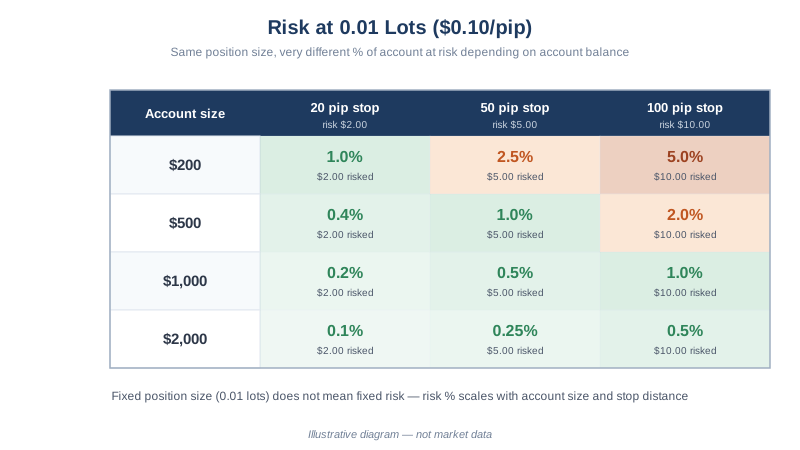
The micro-lot column is the one that matters most for small accounts, because 0.01 lots is the smallest size nearly every broker accepts and so sets a floor under the risk of a single trade. On a USD-quoted pair that floor is 10 cents per pip: a 50-pip stop risks 5 dollars whatever the account size, and a 1% rule needs at least 500 dollars of equity before it can be followed at all. On a yen-quoted pair the micro-lot pip is 10 yen, converted through USD/JPY for a dollar account. The guide on how much capital a forex EA needs works through what that floor means for a grid, where several micro lots are open at once and the floor applies to each of them.
Nano lots of 100 units, where a broker offers them, pay one tenth of the micro figure and extend the table one more column to the right; most brokers do not offer them on standard accounts, which is why the table stops at micro. Ready to check your own figures on a live symbol specification? Open a free XM account and compare the per-lot pip value it shows against this table on a demo before sizing a real trade.
Related Tables and Guides
- Forex Lot Sizes Explained — the four lot sizes and the position-sizing formula that uses pip value
- Forex Average Daily Range Table — how many pips each of these pairs moves in a day
- Forex Pair Correlation Table — which of these pairs move together, for sizing more than one position
- Forex Risk Management Guide — the fixed-fraction rule that pip value plugs into
- Position Size Calculator — lots from account size, risk percent and stop distance
This guide is for educational purposes only and is not investment advice. Pip values are fixed conventions, but the exchange rate that converts them to an account currency changes continuously; verify against your broker’s platform. Forex trading carries substantial risk and most retail traders lose money.