Why Regulatory Badges Aren’t Interchangeable
Every forex broker’s homepage displays regulatory badges — logos, licence numbers, phrases like “multi-regulated” or “fully licensed.” These badges are not interchangeable. A licence from a top-tier regulator and a licence from an offshore registry can sit side by side on the same page while protecting you in almost entirely different ways, and in different amounts.
This guide generalizes something we found the hard way while reviewing XM’s own regulatory claims: a licence number quoted on a review site is not evidence, entity names get reused across jurisdictions, and the only page worth trusting is the regulator’s own register. Below is what each licence tier actually means, what it protects, why brokers hold more than one, and a step-by-step walkthrough for verifying a claim yourself in a few minutes.
The Three License Tiers
Regulators are not ranked on a single official scale, but in practice forex regulation clusters into three tiers by what they require of a broker and what they give you if something goes wrong.
Tier 1 — strict-disclosure regulators. The UK’s Financial Conduct Authority (FCA) and, within the EU, national regulators applying the shared EU framework such as Cyprus’s CySEC. These require minimum capital, regular audits, client-money segregation rules, and — since 2018 in the EU and 2019 in the UK — retail leverage caps. Both back eligible client claims with a statutory compensation scheme, funded independently of the broker.
Tier 2 — moderate regulators. Bodies like Australia’s ASIC or the UAE’s DFSA. They require licensing, some capital and conduct standards, and in ASIC’s case a leverage cap and dispute-resolution scheme (AFCA), but the specifics — compensation cover, exact leverage limits, enforcement intensity — vary by regulator and are worth checking individually rather than assuming.
Tier 3 — offshore registrations. Bodies such as the Belize Financial Services Commission (FSC), the Vanuatu Financial Services Commission, Mauritius’s FSC, or Seychelles’ FSA. These confirm the company is a registered legal entity permitted to offer financial services from that jurisdiction. They typically involve lighter capital requirements, less frequent auditing, and — the point that matters most for your money — usually no statutory compensation scheme at all. Leverage caps are frequently absent or very high; 1:500 and 1:1000 are common offers from offshore entities specifically because the tier-1 caps don’t apply there.
None of this means a tier-3 licence is fraudulent. It means the licence confirms the company’s legal existence and a base level of local compliance — not the layered protections a tier-1 licence carries.
Canada — a Fourth Structure, Not a Fourth Tier
Canada doesn’t map cleanly onto the FCA/CySEC/ASIC/offshore ladder above. Forex and CFD dealers serving Canadian residents are regulated by CIRO, the Canadian Investment Regulatory Organization, a national self-regulatory organization formed on 1 January 2023 from the merger of the Investment Industry Regulatory Organization of Canada (IIROC) and the Mutual Fund Dealers Association (MFDA), as published by CIRO. CIRO members must segregate client funds and participate in the Canadian Investor Protection Fund (CIPF), which covers eligible claims up to CAD $1 million for general accounts combined, a separate CAD $1 million for registered retirement accounts combined, and a separate CAD $1 million for RESPs combined, as published by CIPF — comparable in scale to the FCA’s and CySEC’s schemes, structured differently. Where Canada departs from the FCA/ESMA/ASIC model is leverage: instead of one published ratio applying across major pairs, CIRO sets minimum margin requirements per currency pair through a periodically updated rate list, so a Canadian account’s effective leverage on a given pair is not a single memorable number the way 30:1 is for the FCA or ESMA — check CIRO’s current margin list rather than assuming a figure.
What Each Protection Actually Covers
“Regulated” gets used as one word for several distinct protections. They don’t come as a bundle — a given entity may have some and not others.
| Protection | What it means | Where it typically applies |
|---|---|---|
| Segregated client funds | Client money is held in accounts separate from the firm’s operating capital, so it can’t be used to pay the firm’s own creditors or expenses | Required by tier-1 and most tier-2 regulators; offshore entities may claim it without independent audit |
| Negative balance protection | You cannot lose more than your account balance, even in a fast gap move | Mandated for retail clients under EU/UK rules since 2018-2019; not guaranteed offshore |
| Statutory compensation scheme | An independent fund pays eligible clients if the firm itself fails — not if you lose money trading | FCA: Financial Services Compensation Scheme, up to £85,000 per eligible person per firm, as published by the FSCS. CySEC: Investor Compensation Fund, capped at the lower of 90% of the claim or €20,000, as published by CySEC. CIRO (Canada): Canadian Investor Protection Fund, up to CAD $1 million per account category combined, as published by CIPF. Most offshore regulators: none |
| Leverage caps | A ceiling on how much exposure you can take per unit of margin, set by the regulator, not the broker | EU regulators (following ESMA’s 2018 measures): 30:1 on major FX pairs, 20:1 on minor pairs and gold, down to 2:1 on crypto, as published by ESMA. FCA: the same structure under its 2019 rules, confirmed permanent. ASIC: 30:1 on major FX pairs from 29 March 2021, as published by ASIC. CIRO (Canada): per-pair minimum margin rates published on a rate list, not a single ratio — check CIRO’s current list. Offshore: frequently unrestricted |
| Formal complaint recourse | An independent ombudsman or dispute body you can escalate to if the broker won’t resolve a complaint | FCA-regulated firms: the Financial Ombudsman Service. ASIC-regulated firms: AFCA. Offshore entities: usually none beyond the firm’s own internal process |
The leverage cap deserves a second look, because it is routinely marketed backwards. High leverage is not a benefit to the trader — it is a risk feature the broker is permitted to offer because the regulator doesn’t require it be capped. At 1:1000, a single standard EUR/USD lot needs roughly $100 of margin, and a 10-pip adverse move against you is roughly $100 — the entire margin, gone in a move most currency pairs make routinely inside a single session. Regulators cap leverage near 1:30 for major pairs specifically because uncapped leverage is a documented driver of fast, total account losses, not because it slows down profitable trading.
Why One Broker Runs Multiple Entities
Almost every large forex broker operates as a group of separate legal companies under one brand, each licensed somewhere different, each accepting a different set of countries. This is not necessarily concealment — it is how a broker legally serves a global client base under overlapping and sometimes conflicting national rules. A firm licensed only in the EU generally cannot lawfully solicit US residents; a firm wanting to offer 1:500 leverage cannot do so to EU retail clients through its EU entity, so it offers that leverage through a separate offshore entity instead.
The practical consequence: the regulatory badges on a broker’s marketing homepage are not all available to you. Which entity you are actually contracted with — and therefore which protections apply — is decided by your country of residence and stated in the client agreement you sign during onboarding, not by which logo caught your eye on the landing page. We found exactly this pattern reviewing XM: EEA residents are generally onboarded to the CySEC-regulated Cyprus entity, UAE residents to the DFSA entity, and most other applicants to the Belize FSC entity — each with a different compensation scheme, or none, and a different maximum leverage. See the entity comparison table in our XM review for a worked example with the specific entities and what changes between them.
Step-by-Step: Verify a Broker’s License Yourself
This takes about five minutes and requires nothing but the browser you’re already using. Multiple entities under one brand is exactly why the check has to be entity-by-entity, not badge-by-badge. For a screen-by-screen version of these five steps — the exact search fields on the FCA, ASIC, CySEC, FSCA and NFA lookup tools, and what a genuine result looks like — see how to verify a forex broker’s license yourself.
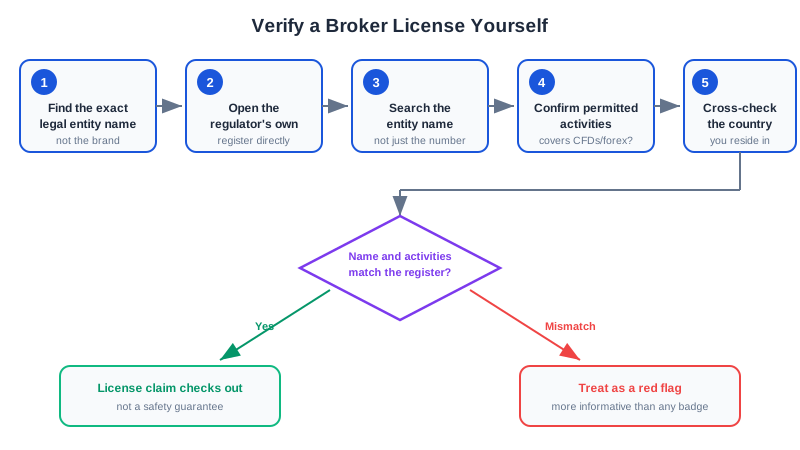
- Find the exact legal entity name, not the marketing brand. It’s usually in the footer of the broker’s website, in the client agreement, or in the “legal documents” section — look for wording like “operated by [Company Name Ltd], licensed by [Regulator].”
- Go to the regulator’s own register directly — never a broker-comparison site, a review aggregator, or a link the broker itself provides. Type the regulator’s domain in yourself:
- FCA (UK): register.fca.org.uk, or the simpler FCA Firm Checker
- CySEC (Cyprus): the regulated Cypriot investment firms list
- Belize FSC: the registered entities search
- ASIC (Australia): the ASIC Connect professional registers
- CIRO (Canada): the Advisor Report search tool
- Search the legal entity name, not the licence number alone. Numbers get copied forward on review sites for years after an entity is renamed, sold, or wound down — matching the name first tells you whether you’re even looking at a live registration.
- Confirm what the entity is licensed to do. A registration can exist for a category of financial service that doesn’t include CFDs or retail forex at all. The register entry states the permitted activities — read them.
- Cross-check the country match. If you are a UK resident and the register confirms only an offshore entity, the FCA badge on the homepage is not the entity you would actually be trading through.
If any of these steps turn up a mismatch — a different entity name, a lapsed registration, permissions that don’t cover what you’d be trading — treat that as more informative than anything on the broker’s own marketing pages.
Putting the Tiers Together
Regulation tier is one input into broker choice, not the whole decision, and a tier-3-only broker isn’t automatically unsafe to use — plenty of traders use offshore-regulated accounts deliberately, for the higher leverage or lower minimum deposit, understanding the trade-off. What matters is knowing which trade-off you’re making before you fund the account: whether a compensation scheme stands behind your deposit if the firm fails, what leverage ceiling applies, and whether you have anywhere to escalate a dispute beyond the firm itself. All three of those are answered by the entity’s actual registration, checked on the regulator’s own site — never by the badge count on a homepage.
If you’re choosing where to run automated trading specifically, pairing this with our guide on what to check before trusting a forex EA and our breakdown of spreads and commissions covers the two questions regulation alone doesn’t answer: whether the strategy is sound, and what it actually costs to run.
Frequently Asked Questions
Is a CySEC-regulated broker safe?
CySEC regulation gives you real, checkable protections that an offshore-only broker does not: segregated client funds, negative balance protection, and access to the Investor Compensation Fund, capped at the lower of 90% of your claim or 20,000 euros, as published by CySEC. That is meaningfully better than no compensation scheme, but it is not a safety guarantee — CySEC firms have still failed and been fined. Regulation lowers certain risks; it does not remove market risk or firm-specific risk.
What is the difference between FCA and offshore forex regulation?
The FCA (UK) requires client fund segregation, caps retail leverage at 30:1 on major currency pairs under its 2019 rules, and backs eligible claims with the Financial Services Compensation Scheme up to £85,000 per person per firm, as published by the FCA and FSCS. A typical offshore regulator (Belize FSC, Vanuatu, Seychelles, and similar) sets a much lower compliance bar, usually has no statutory compensation fund at all, and often permits leverage up to 1:1000. Both can be legally valid licences; they protect you very differently.
Why does one broker have multiple regulatory licences?
Because a single brand typically operates several separate legal entities, each licensed in a different jurisdiction, and routes each client to whichever entity is allowed to accept them. A trader in the EEA is usually onboarded to the EU-regulated entity; a trader in a country with no reciprocal arrangement is usually onboarded to an offshore entity carrying the same brand. The licences listed on a broker’s homepage are not all available to you — only the one attached to the entity you are actually contracted with matters.
How do I check if a broker’s license claim is real?
Go to the regulator’s own official register, not a broker directory or comparison site, and search the exact legal entity name printed in your account-opening documents or client agreement — not just the marketing brand. The FCA’s Financial Services Register (register.fca.org.uk), CySEC’s regulated-entities list (cysec.gov.cy), and the Belize FSC’s licence verification portal (belizefsc.org.bz) are all free and public. If the entity name on the register doesn’t match what you signed, the licence number on the broker’s website is not evidence of anything for your account.
Is CIRO regulation in Canada comparable to FCA or CySEC?
Partially, and the structure differs. CIRO (the Canadian Investment Regulatory Organization, formed January 2023 from the merger of IIROC and the MFDA, as published by CIRO) is a national self-regulatory organization requiring member firms to segregate client funds and back eligible claims with the Canadian Investor Protection Fund, covering up to one million Canadian dollars per general-account category, per registered-retirement-account category, and per RESP category, each combined separately, as published by CIPF. Where it differs from FCA or ESMA-style regulation is leverage: CIRO sets minimum margin requirements per currency pair through a published rate list rather than one flat ratio like the FCA’s or ESMA’s 30:1 cap on majors, so check CIRO’s current list rather than assuming a single number applies.
Open an XM account if you’ve checked the entity you’d be onboarded to and the trade-off works for you — or read the full XM regulatory breakdown first.
Next Steps
- XM Broker Review 2026: Spreads, Regulation, and Trading Conditions
- How to Choose a Forex EA in 2026
- Understanding Spreads and Commissions
- Forex Risk Management Guide
This article is educational and not personalised financial advice. Verify all regulatory claims on the relevant regulator’s own register before opening an account. Full disclaimer