How to Open a Forex Demo Account
A demo account trades a live price feed with virtual money. It is genuinely useful for a narrow set of things: learning the platform, verifying that your rules produce the trades you expect, and forward-testing an Expert Advisor. It is also routinely oversold, so start with what it does not do.
This is the step our forex trading for beginners roadmap recommends before any live deposit.
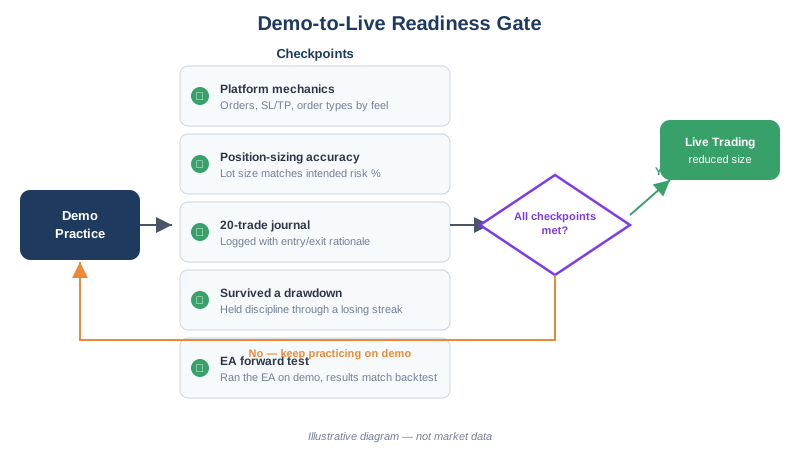
The Five-Gate Go-Live Checklist
Before moving a dollar of real capital, tick off five gates in order. Skipping ahead defeats the point of practising on demo at all — each gate below has its own section further down this page with the pass criterion in full.
- Gate 1 — Order mechanics. Place, modify, and close 10 orders correctly, each with a stop and target set before entry.
- Gate 2 — Sizing accuracy. Ten trades sized from a fixed 1% risk, each realised loss landing within ±10% of the plan.
- Gate 3 — The 20-trade journal. Twenty trades logged with all eight fields covered below, and you can state your win rate and average win/loss without recomputing.
- Gate 4 — Drawdown survival. Four consecutive losses, or a 5% equity drawdown, without changing lot size, moving a stop, or abandoning the plan.
- Gate 5 — EA forward test. One EA run unattended for at least 30 days or 20 trades, with every trade traceable to a rule.
All five gates map onto the six-week programme below, one or two per week, with the journal fields and sizing math spelled out in their own sections further down. None of the five gates is “consistent demo profitability” — that omission is deliberate and explained further down.
What a Demo Account Cannot Teach You
A demo account is a mechanics simulator, not a risk simulator. The table below is what changes the moment real money replaces virtual money.
| What demo gives you | What live gives you instead | Why it matters |
|---|---|---|
| No loss aversion — a $200 demo loss costs nothing | Money that matters, which is what triggers widened stops, doubling after a loss, and cutting winners early | Discipline shown on demo proves nothing about discipline shown live, because demo cannot trigger the failure it claims to test |
| Idealised fills at the requested price | A queue with a variable spread against your order | Your realised entry price differs from your planned one |
| No slippage on stops | A stop hit during a fast move executes at whatever is available next | During a rate decision or payrolls release, that gap can be several times the distance you thought you were risking |
| Spreads that are frequently cleaner than live | Wider spreads at the daily rollover and around scheduled news | If your strategy’s average win is under about 10 pips, this gap can be most of the edge — see understanding spreads and commissions |
The named failure mode: the demo hero. A 300% demo return achieved at lot sizes you would never risk live, on a balance you would never deposit. It looks like evidence of skill and is evidence of sizing. If your demo balance is $100,000 and you intend to deposit $500, none of it transfers.
Open a Demo Account with XM in 4 Steps
- Visit XM's website and choose the demo option
- Fill in your details and select MetaTrader 4 or MetaTrader 5
- Set the virtual balance to the amount you actually intend to deposit — not the maximum offered
- Credentials arrive by email; install the platform and log in with the demo server selected
No capital is at risk while you practise. That is the honest version of the claim. The account is a simulator, not trading with the risk taken out, because the one thing it cannot simulate is what real money does to your decisions.
Match Demo Leverage to Your Live Account, Not the Default
Many brokers pre-select a high default leverage on new demo accounts — sometimes 1:500 or higher — regardless of what your eventual live account will actually carry. If you’re planning to trade live through an FCA-, CySEC-, or ASIC-regulated entity, that default doesn’t match reality: ESMA caps retail leverage on major FX pairs at 30:1 for EU-regulated accounts (Board of Supervisors decision, 23 March 2018, effective 1 August 2018, as published by ESMA), the FCA applies and has confirmed the same structure permanently for UK retail clients, and ASIC applies the same 30:1 cap for Australian retail clients from 29 March 2021, as published by ASIC. Practising at a higher demo leverage than your live account will actually be capped at means the lot sizes and margin usage you get comfortable with on demo won’t transfer — set the demo leverage to match the regulated cap you expect to trade under before starting the programme below, using the position-size calculator to check what that cap does to your available lot size at a given balance.
The Six-Week Programme: Gates 1–5, Week by Week
Each week has one focus and one pass criterion. Do not advance on a week you failed — repeat it.
| Week | Focus | Pass criterion |
|---|---|---|
| 1 | Platform mechanics | Place, modify and close 10 orders. Every one carries a stop and a target set before entry. Zero orders in the wrong direction or the wrong lot size. |
| 2 | Sizing accuracy | For 10 trades, compute lot size from a fixed 1% risk before entry. Each realised loss lands within ±10% of the planned figure. |
| 3–4 | The 20-trade journal | 20 trades logged with all eight fields below. You can state your win rate and average win/loss from the log without recomputing. |
| 5 | Survive a drawdown | Trade through four consecutive losses, or a 5% equity drawdown, without changing lot size, moving a stop, or abandoning the plan. |
| 6 | EA forward test | Run one EA unattended for at least 30 days or 20 trades. Every trade it takes is one you can trace to a rule. No manual intervention. |
Week 5 cannot be scheduled — you wait for the losing run, and it arrives. Most traders take longer than six calendar weeks for that reason, which is the correct outcome. Note what is deliberately not on the list: consistent demo profitability. Over 20 trades, profitability is mostly noise — our backtesting guide shows even 100 trades leaves a wide interval. Process criteria are testable at that sample size; edge is not.
For week 2’s sizing-accuracy check, work out each trade’s expected lot size before entry with the position-size calculator rather than doing the arithmetic by hand — that removes one source of the ±10% error the pass criterion is trying to catch.
Gate 3: What to Record in a Journal
Eight fields, each catching a specific error.
| Field | Why it is there |
|---|---|
| Entry and exit timestamps | Lets you find the chart again, and shows whether losses cluster in one session |
| Symbol and direction | The cheapest way to find a directional bias you did not know you had |
| Planned risk, in currency and % | Catches sizing drift before it compounds |
| Lot size | Cross-check against planned risk — a mismatch here is the most common demo error |
| Entry, stop and target prices | Lets you compute intended reward-to-risk before the outcome is known |
| Reason for entry, one sentence | If you cannot name the rule, it was not a system trade. Count these. |
| Exit reason: stop, target, or manual | Manual exits are where discretion leaks back in. A rising manual count is the warning. |
| Result in R, not currency | R — multiples of the risk taken — makes trades comparable across balances and lot sizes |
The last field is the one people skip and the one that matters. A $40 win and a $12 win tell you nothing side by side if the positions were different sizes; +2.0R and +0.4R tell you everything.
After All Five Gates: Demo-to-Live Sizing
Two rules: deposit about a quarter of the demo balance you practised on, and trade about a quarter of the lot size. The quarter is not really about the money — it buys room to discover that your live behaviour differs from your demo behaviour before that discovery gets expensive.
The table assumes EUR/USD, a 30-pip stop, 1% risk per trade, and $10 per pip per standard lot (so $0.10 per pip at 0.01 lots).
| Demo balance | Demo lot at 1% | Suggested first live deposit | First live lot |
|---|---|---|---|
| $1,000 | 0.03 | $250 | 0.01 |
| $3,000 | 0.10 | $750 | 0.02 |
| $5,000 | 0.16 | $1,250 | 0.04 |
| $10,000 | 0.33 | $2,500 | 0.08 |
Check one row: $3,000 × 1% = $30 of risk; $30 ÷ 30 pips = $1.00 per pip; $1.00 ÷ $10 = 0.10 lots.
The constraint that bites at the bottom. At a $250 deposit, 1% over a 30-pip stop is $0.083 per pip — about 0.008 lots, below the 0.01 minimum. You cannot size down further, so one micro lot already risks roughly 1.2% of the account. Either accept the higher percentage knowingly, deposit more, or use a micro account type where the contract size is 1,000 units rather than 100,000. This floor is the real reason a small live account feels different from the demo, and it is worth understanding before you fund one — see lot sizes explained, the risk management guide, and what a minimum deposit actually buys at various small-balance levels.
Our free EAs can all be run on demo first — download them and follow the installation guide.
Related Guides
- Forex Trading for Beginners — the roadmap this step belongs to
- Forex Risk Management Guide — sizing and drawdown limits
- First Trade Checklist — before the first live position
- Lot Sizes Explained — the arithmetic behind the demo-to-live sizing table above
Affiliate Disclosure: this page contains affiliate links. We are an XM Introducing Broker and are paid when you open an account through them. Full disclosure.
Risk Warning: when you move to live trading, forex and CFD trading carries significant risk of loss. Never trade with money you cannot afford to lose. Read our risk disclosure.