Pair Selection Is a Data Problem, Not a Preference
Not all currency pairs work for grid trading. The wrong pair can turn a profitable grid into a losing one — wide spreads eat your profits, strong trends blow through your levels, and low liquidity causes slippage. Picking a pair by feel or by whichever one you already trade skips the part of the decision that actually determines whether a grid survives its first trending month.
This guide ranks 7 forex pairs for grid trading against three measurable criteria, in order of how much each one matters:
- Range behavior — how often the pair moves sideways vs. trending
- Spread cost — how much each grid level costs to open, relative to the other majors
- Typical daily range — sets the ceiling on how wide (or tight) grid spacing should be
The Three Criteria That Decide Grid Suitability
Before adding any pair to your grid, run it against these criteria rather than a gut feel:
| Factor | What to Look For | Why It Matters |
|---|---|---|
| Typical daily range | Moderate, not extreme | Too little movement means levels rarely fill. Too much means dangerous position accumulation on a single side |
| Spread | Tight relative to other majors | Each grid level opens at a loss equal to the spread. A tighter spread reaches breakeven on fewer pips of favorable movement |
| Range behavior | Ranges more often than it trends | A pair that spends most sessions oscillating inside a band is structurally suited to a grid; a pair that trends persistently is not |
| Session behavior | Clear ranging sessions | Grid trading works best during specific sessions (e.g., Asian for EUR/USD), not around the clock |
Typical daily range is a moving target, not a fixed number — the same pair can sit near the bottom of its usual band one week and the top of it the next. For the two pairs where we publish dated, sourced range data, see the EUR/USD average daily range guide and the USD/CAD average daily range guide; both are refreshed with an as-of date rather than quoted as a static fact. USD/CAD is not one of the seven ranked below, but its 20-day ADR measured 55.0 pips as of July 31, 2026 (Dukascopy daily bars, via our USD/CAD ADR guide) — a useful sourced reference point for how a moderately ranging major compares to the pairs that are ranked. Traders who do not want to re-pick a spacing every time the regime shifts use dynamic grid trading instead, deriving the interval from a live ATR reading so pair selection and spacing selection stop being two separate chores.
The spread row above is the one most easily underestimated, because the quoted spread is only one of four costs a filled level pays: work through what a forex round trip actually costs for your own pair before deciding a spread is tight enough to grid against.
Ranging vs. Trending, at a Glance
The criteria above only matter because of one underlying difference in how a pair’s price path behaves. A grid profits when price keeps returning through the same band of levels; it accumulates unmanaged risk when price leaves that band and does not come back.
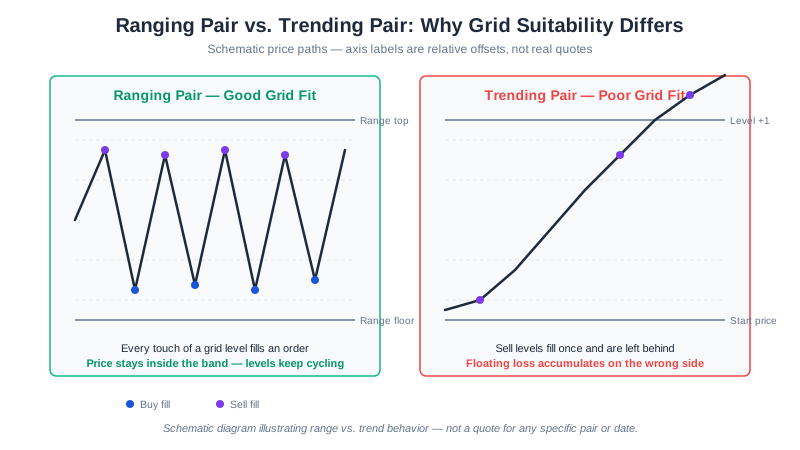
Every pair ranked below is scored against how closely its typical behavior matches the left panel rather than the right one.
The 7 Pairs Ranked by Grid Suitability
1. EUR/USD — The Gold Standard for Grid Trading
EUR/USD is the best forex pair for grid trading on every criterion above. It is the most heavily traded pair in the world, which keeps its spread among the tightest of any pair and its liquidity deep enough that grid orders fill without meaningful slippage.
- Typical daily range: roughly 60-90 pips through 2026, as published by SteadyPips’ EUR/USD average daily range guide, as of August 2026
- Spread: consistently among the tightest of any pair, a direct result of being the most liquid pair traded
- Suggested starting grid spacing: a fraction of the current ADR reading above — see the guide’s grid-spacing discussion for how to size it
- Best session: Asian and early European (tends to range)
- Suggested starting capital: roughly $500-$800 for micro lots (0.01), consistent with the GridMaster settings table in our free EA download guide
EUR/USD tends to oscillate within a defined range more often than it trends outright, which is the structural reason it heads this list. Our GridMaster EA ships with EUR/USD defaults chosen for this pair’s typical range behavior.
2. AUD/NZD — The Range-Bound Specialist
AUD/NZD is a favorite among grid traders because Australia and New Zealand have closely correlated economies, which keeps the pair oscillating rather than trending for extended stretches.
- Range behavior: has held inside a broad multi-year band rather than establishing a persistent trend
- Spread: noticeably wider than EUR/USD, which slows how quickly each grid level turns profitable
- Suggested starting grid spacing: narrower than EUR/USD’s, given a typically tighter daily range — confirm against your own ADR reading before committing capital
- Best session: Asian session
- Suggested starting capital: roughly $500 for micro lots
The wider spread compared to EUR/USD is the main tradeoff: each grid level costs more to open, so the range needs to be genuinely well-behaved to compensate.
3. EUR/GBP — Tight Range, Tight Spread
EUR/GBP combines low volatility with a spread that is competitive among crosses, though not as tight as EUR/USD’s.
- Range behavior: historically one of the more range-bound crosses, with a narrower typical daily range than EUR/USD
- Spread: tighter than most crosses, though still wider than EUR/USD
- Suggested starting grid spacing: tighter than EUR/USD’s, reflecting the smaller typical range — a narrow range needs a narrow interval to generate enough fills
- Best session: European session overlap
- Suggested starting capital: roughly $400 for micro lots
The narrow typical range means smaller absolute pip targets per trade, but the historically range-bound behavior makes the grid mechanics easier to size. That is a structural fit, not a guarantee of profitability.
4. USD/CHF — The Safe Haven Ranger
USD/CHF tends to mirror EUR/USD inversely, creating ranging opportunities when EUR/USD ranges.
- Range behavior: correlated inversely with EUR/USD, so it tends to range on the same sessions EUR/USD does
- Spread: moderate among the majors — wider than EUR/USD, tighter than most crosses
- Suggested starting grid spacing: in the same neighborhood as EUR/USD’s, widened further during risk-off macro periods
- Best session: European and early US
- Suggested starting capital: roughly $500 for micro lots
Be cautious during risk-off events — CHF can spike sharply as a safe haven currency. Widen spacing during uncertain macro environments rather than leaving it at a calm-market default.
5. USD/JPY — Predictable but Watch for Trends
USD/JPY offers tight spreads and good liquidity, but trends more persistently than EUR/USD.
- Range behavior: ranges well during calm macro periods but is more prone to sustained directional runs than EUR/USD
- Spread: among the tighter majors, comparable to EUR/USD
- Suggested starting grid spacing: wider than EUR/USD’s, to give the pair’s larger typical swings room before triggering the position cap
- Best session: Asian and US sessions
- Suggested starting capital: roughly $800 for micro lots
USD/JPY can trend aggressively during BOJ interventions or US rate decisions. A momentum filter — pausing the grid when a trend-strength indicator like ADX moves well above its neutral range — is a commonly used technique to avoid trend traps, though it is a heuristic, not a guaranteed rule. Learn more in our grid trading strategy guide.
6. GBP/USD — Higher Volatility, Higher Reward
GBP/USD offers larger pip movements but requires more capital and wider spacing than EUR/USD.
- Range behavior: trends more aggressively than EUR/USD, with wider typical daily swings
- Spread: wider than EUR/USD, in line with the pair’s larger typical range
- Suggested starting grid spacing: meaningfully wider than EUR/USD’s to match the larger range
- Best session: London session
- Suggested starting capital: roughly $1,000-$1,500 for micro lots
The wider typical range means more potential profit per grid level, but the pair also trends more aggressively than EUR/USD. Not recommended for beginners — start with EUR/USD and graduate to GBP/USD once your grid setup is proven.
7. EUR/CHF — Post-SNB Ranger
After the Swiss National Bank removed the EUR/CHF floor in 2015, the pair found a new equilibrium and has generally ranged within a broad band since.
- Range behavior: consistent ranging behavior since 2015, though watch for SNB policy surprises which can move it sharply
- Spread: wider than EUR/USD, comparable to other minor crosses
- Suggested starting grid spacing: similar to EUR/GBP’s — a narrower band than EUR/USD calls for a narrower interval
- Best session: European session
- Suggested starting capital: roughly $500 for micro lots
EUR/CHF offers consistent ranging but the wider spread makes it less profitable per level than EUR/USD, and SNB policy surprises are the main tail risk.
Pairs to Avoid for Grid Trading
| Pair | Why It Fails |
|---|---|
| GBP/JPY | Far more volatile than the pairs above, with a daily range wide enough to blow through most grid spacing, and trends aggressively |
| USD/TRY | Spreads dramatically wider than the majors above, and a currency that has trended persistently in one direction for years |
| USD/ZAR | Wide spreads, thinner liquidity, strong and persistent trend bias |
| XAU/USD | Daily range far exceeds any forex major, with long one-directional macro moves |
| Any crypto pair | Trends for weeks or months at a time, and spread/funding costs are prohibitive for a strategy that depends on frequent small fills |
Pair Correlation and Portfolio Grid Trading
If you grid trade multiple pairs simultaneously, check their correlation to avoid doubling your risk:
- EUR/USD + USD/CHF — strongly negatively correlated. Trading both is essentially doubling your EUR/USD exposure in opposite directions
- EUR/USD + GBP/USD — moderately correlated. Some diversification but not full
- EUR/USD + USD/JPY — low correlation. A reasonable diversification pair
- AUD/NZD + EUR/GBP — near-zero correlation. A reasonable combination for portfolio grid trading
These are directional relationships worth knowing, not fixed coefficients — correlation between any two pairs drifts over time and should be checked against current data before sizing a multi-pair grid, not assumed from a rule of thumb.
Getting Started
The fastest way to start grid trading on these pairs is with a free EA that handles the mechanics automatically.
- Download GridMaster EA (free for MT4 and MT5) — pre-configured for EUR/USD
- Set up your grid with our step-by-step guide
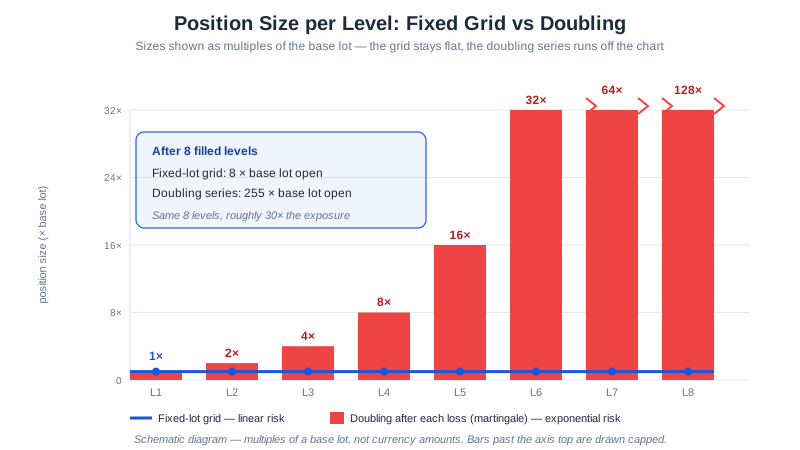
- Understand grid vs. martingale risk before going live
Start on a demo account. Adjust spacing based on the pair’s current ADR. Never risk more than 2% of your account per grid level.
Trading a small account? See our best forex pairs for small accounts post for how margin requirements narrow this list further.
What to Read Next
- Grid Trading Strategy: Complete Guide — the full mechanics behind pair choice here
- How to Set Up Grid Trading — turning a chosen pair into a running grid
- EUR/USD Average Daily Range Guide — the dated, sourced ADR figure behind the #1 pair on this list
- USD/CAD Average Daily Range Guide — a sourced ADR reading for a pair outside this top 7
- Volatility-adaptive dynamic grid trading — letting ATR set the spacing for whichever pair you pick
- Grid Trading vs Martingale — why flat lot sizing matters as much as pair choice
- Best Forex Pairs for Small Accounts — pairing a small deposit with the right instrument
Trading foreign exchange carries a high level of risk and may not be suitable for all investors. Past performance is not indicative of future results.
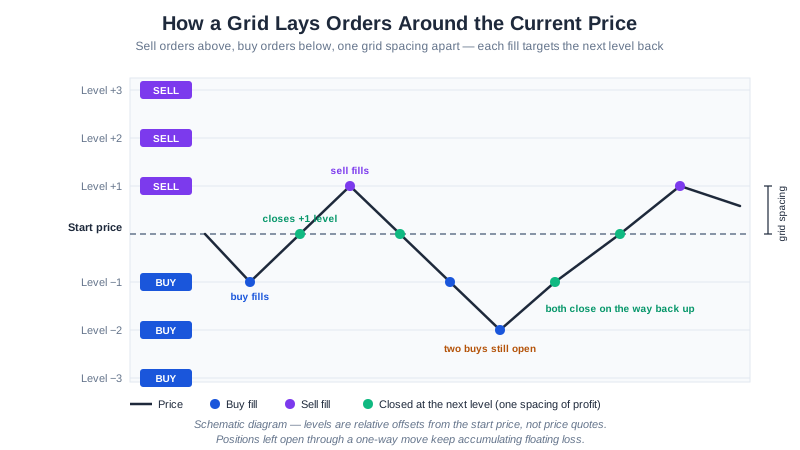
![Forex Grid Trading Strategy: Complete Guide + Free EA [2026]](/images/charts/grid-trading-pattern.png)