Not All Automated Trading Algorithms Work the Same Way
If you’re new to automated trading, start with What Is an Expert Advisor? — it covers what an EA is, how it runs on your platform, and whether automation is profitable in general. This guide assumes that background and goes one level deeper: the different algorithm types EAs implement, and why the type matters more than the marketing around it.
“Automated trading” is not one strategy. A trend-following algorithm and a grid-trading algorithm can both be labeled “EA” while having almost opposite risk profiles, opposite behavior in a ranging market, and opposite capital requirements. Choosing between them — or combining them — is a bigger factor in your results than any single input parameter.
Quick Answer
Automated forex trading is carried out by four distinct algorithm families, and the family determines the risk profile: trend following trades the direction of an established move, grid trading works price oscillation inside a range, scalping takes many small profits from tiny moves, and mean reversion fades deviations back toward an average. Trend following and scalping need directional or fast-moving conditions; grid and mean reversion need ranging ones. Which family an EA belongs to matters more to your results than any single input parameter.
Algorithm Types Compared
| Algorithm type | Profit source | Works best in | Main weakness | Our example |
|---|---|---|---|---|
| Trend following | The direction of an established move | Directional markets | False signals in ranges; slower to enter | SteadyPips EA |
| Grid trading | Price oscillation inside a range | Range-bound markets | Large drawdowns in strong trends; needs more capital | GridMaster EA |
| Scalping | Many small price movements, held seconds to minutes | Fast, liquid, tight-spread conditions | Highly sensitive to spread and execution speed | — |
| Mean reversion | Price returning to an average after deviating | Range-bound markets | Fails during breakouts and trend shifts | — |
SteadyPips classifies EA logic into four families — trend following, grid, scalping, and mean reversion — and treats the family, not the input parameters, as the primary determinant of an EA’s risk profile and capital requirement (SteadyPips, as of August 2026).
Which Automation Path Fits You?
The four families split along two questions, not one. First: does the pair and timeframe you trade spend more time trending or ranging? Second, inside whichever regime you picked: do you want few, patient entries, or many, fast ones? Answer both and you land on a family — not a recommendation to buy one specific EA, but a narrower set of logic to evaluate.
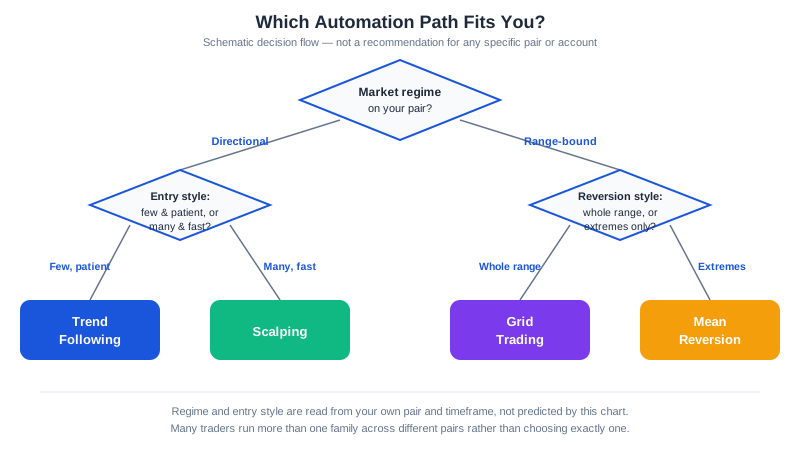
This is how the choice between trend-following and grid trading actually gets made in practice: not by which one markets itself better, but by which one matches how the pair you watch actually behaves, and how much attention you intend to give it.
Directional, Few and Patient: Trend Following
Trend-following EAs identify the direction of the market and trade with it. They typically use moving averages, momentum indicators, or breakout signals.
Strengths: Clear logic, lower drawdowns, works well in directional markets Weaknesses: Frequent false signals in ranging markets, slower to enter trends
Our SteadyPips EA uses a trend-following approach with EMA crossovers and ATR-based risk management.
Directional, Many and Fast: Scalping
Scalping EAs take many small profits from tiny price movements, often holding trades for seconds to minutes.
Strengths: High win rate, many opportunities Weaknesses: Sensitive to spreads and execution speed, requires very fast connection
Range-Bound, Whole Range: Grid Trading
Grid trading places buy and sell orders at fixed intervals around the current price. It profits from price oscillating within a range, without needing to predict direction.
Strengths: Direction-independent, high trade frequency, automation-friendly Weaknesses: Large drawdowns during strong trends, requires more capital
Our GridMaster EA implements adaptive grid trading with built-in equity protection. Learn the full strategy in our grid trading guide. Because a grid EA typically holds several positions open across multiple days, overnight swap charges compound faster than they do on a single-entry strategy — see our swap-free (Islamic) forex accounts guide for how a swap-free account changes that specific cost.
Range-Bound, Extremes Only: Mean Reversion
Mean reversion strategies bet that price will return to an average after deviating from it. They buy when price is “too low” and sell when it is “too high” relative to a moving average or band.
Strengths: Works well in range-bound markets Weaknesses: Fails during breakouts and trend shifts
Many traders don’t land on exactly one leaf and stop there — running trend-following on one pair and grid on another, chosen per pair rather than per account, is a common way to diversify across regimes instead of betting the whole account on reading one regime correctly.
Manual vs Automated Trading
| Factor | Manual Trading | Automated Trading |
|---|---|---|
| Emotional control | Difficult | Eliminated |
| Speed of execution | Seconds | Milliseconds |
| Market monitoring | Limited hours | 24/5 continuous |
| Consistency | Varies with mood | Always consistent |
| Adaptability | High | Limited to programming |
| Learning curve | Analysis skills | Technical + strategy |
| Capital required | Any | Any |
| Backtesting | Time-consuming | Automated and fast |
The ideal approach for many traders is a combination: use EAs for execution discipline while maintaining human oversight for strategy adjustment.
What to Look For in a Forex EA
1. Transparent Logic
Understand what the EA does. If the vendor cannot explain the strategy in plain language, walk away. Black-box systems with “secret algorithms” are a red flag.
2. Built-In Risk Management
Every serious EA must include:
- Maximum position size limits
- Stop-loss on every trade
- Drawdown protection (close all if equity drops too far)
- Lot size calculation based on account balance
An EA blows an account when one of these is missing or set too aggressively, not usually through malice: an unchecked position size or an absent drawdown gate finally meets an adverse run it was never built to survive. Use EAs with all four in place, and start with conservative settings on a small account until you’ve seen the safeguards actually hold during a losing stretch.
3. Backtesting Results
Always backtest an EA on historical data before live trading. Look for:
- At least 2-3 years of data
- Realistic spread and slippage settings
- Maximum drawdown under 20-30%
- Consistent equity curve (not one lucky month)
4. Demo Performance
After backtesting, run the EA on a demo account for at least 2-4 weeks to verify it performs as expected in live market conditions.
5. No Unrealistic Claims
Any EA claiming “99% win rate” or “guaranteed profits” is either a scam or dangerously misleading. Legitimate EAs acknowledge risk and focus on edge over time, not perfection.
Put together, these five checks are also the honest answer to whether automated trading is profitable at all: it can be, with a well-tested strategy and real risk management behind it, but no EA guarantees profits. Results depend on the strategy’s edge, the market conditions it meets, and the risk settings you choose — which is exactly what this checklist exists to verify before capital is at risk.
Why Free EAs Can Be Better Than Paid
Some free EAs are genuinely excellent, particularly ones with transparent logic and built-in risk management. Because they don’t depend on subscription revenue to survive, free EAs from reputable sources can outperform expensive ones without needing to. The forex EA market is flooded with overpriced products that underdeliver — here is why free EAs from reputable sources can be the better choice:
- No vendor lock-in — You are not paying monthly subscriptions that pressure you to keep using a losing system
- Transparent motivation — Free EAs from brokers or affiliates earn revenue from your trading activity, aligning their interest with your success (they want you to keep trading)
- No marketing hype — Paid EAs spend heavily on marketing to recoup development costs, often overpromising results
- Community testing — Free EAs with open strategies get tested by more users, exposing flaws faster
Either way, backtesting the EA yourself before trusting it with real money matters more than what it cost.
Setting Up Your First EA
Step 1: Get a Trading Account
Open a trading account with a broker that supports MetaTrader 4. Open a free XM account to get started.
Step 2: Install MetaTrader 4
Download and install MT4 from your broker. Log in with your account credentials.
Step 3: Install the EA
Follow our step-by-step EA installation guide. The basic process:
- Copy the .ex4 file to MT4’s Experts folder
- Restart MT4
- Drag the EA onto a chart
- Enable automated trading
Step 4: Configure Risk Settings
Start conservative:
- Risk per trade: 1% of account
- Maximum open positions: limited
- Use the EA’s built-in drawdown protection
Read our SteadyPips EA page for detailed configuration and settings.
Step 5: Consider a VPS
A Virtual Private Server is effectively required, not just recommended, for automated trading run seriously: it keeps your EA running 24/5 with stable power and internet even when your own computer is off, and any drawdown protection built into the EA only evaluates while the EA is actually running. VPS services aimed at forex typically start around $10-20 per month — see our Virtual Private Server guide for how to size and set one up.
Step 6: Monitor and Adjust
Automated does not mean “set and forget forever.” Review your EA’s performance weekly:
- Is drawdown within acceptable limits?
- Are market conditions matching the EA’s strategy?
- Do risk settings need adjustment?
Get Started with Free EAs
Download our free Expert Advisors and start automated trading today. See the full EA lineup for all seven builds side by side:
- SteadyPips EA — Trend-following, conservative, low drawdown
- GridMaster EA — Grid trading, range-bound markets, adaptive spacing
Both include full risk management and work on MetaTrader 4 and MetaTrader 5. Download now.
Next Steps
- What Is an Expert Advisor? — the foundational guide this page builds on
- How to Choose a Forex EA in 2026 — the vendor red-flag checklist
- Grid Trading Strategy: Complete Guide — a deeper look at one algorithm type
- How to Backtest a Forex EA — testing any of these algorithm types before going live
This article is for educational purposes only and does not constitute financial advice. Automated trading involves substantial risk, including the possibility of losing more than your initial investment. Past performance is not indicative of future results. Always test on a demo account before trading with real money.